Wednesday, December 28, 2011

James 1

During 2009-2010 I created a series of collages on 9" x 12" paper illustrating all of the Epistle of James. This book is as close as the New Testament gets to the type of wisdom literature found in the Book of Proverbs. The author treats a number of subjects in quick succession utilizing vivid imagery, which lends itself nicely to the type of semi-surrealist style that I favor.

Images for the first chapter of James are shown below:

To the Tribes (James 1:1)


Topsy-Turvy Teaching (James 1:2-4)


Wavering (James 1:5-8)


Ups and Downs (James 1:9-11)


Death's Life Cycle (James 1:12-16)


Shadowless (James 1:17-18)


His Master's Voice (James 1:19-21)


Amnesia (James 1:22-25)


Pure Religion (James 1:26-27)

Saturday, November 5, 2011

St. Peter and St. Paul

I created two matching 11" x 14" visual homages to these giants of the Christian faith using acrylics, collage and metal foil on canvas. Each piece combines images reminiscent of the beginning and end of their respective careers.


Black Icon: St. Peter (2005)

This piece shows the young fisherman who later becomes a true fisher of men, especially at the Day of Pentacost.
.

Gold Icon: St. Paul (2005)

The blind Saul receiving basic Christian instruction from Ananias soon after his encounter with the risen Christ on the road to Damascus is contrasted with the shipwrecked Apostle to the Gentiles, Paul, being preserved from a dangerous snake bite on the Island of Malta while on his way to Rome, where he will ultimately be executed.

Thursday, October 27, 2011

Plague and Provision

The philosophical problem labeled Theodicy is usually formulated as follows: "If God is all-powerful, he could create a world with no evil. If God is good, he would create a world with no evil."  There have been a number of approaches to understanding this problem while still maintaining the twin concepts of God's omnipotence and goodness (for example, C. S. Lewis' The Problem of Pain). 

One inadequate approach from a Biblical viewpoint is to deny that God has any responsibility for the presence of evil in the world.  Isaiah 45:7 quotes God as saying, "I form light and create darkness; I make weal and create woe; I the LORD do all these things." (NRSV)

The twin collages below picture God's control over all that we encounter in this world, those things we label as "good" and those we call "bad." We should realize that even the latter may ultimately further God's plans for the world as a whole and for our lives individually. Images from both past and present are intermingled in these pieces to demonstrate the timelessness of this concept.

Plague (2005)
16" c 20"


Provision (2005)
16" x 20"

Saturday, September 24, 2011

Messing with the Masterpieces

As an exercise in composition, I selected six oil masterpieces illustrating the early life of Christ. I then used these as inspirations for 11" x 14" collages created from magazine illustrations on hand. The (somewhat uneven) results are given along with the originals. The first one shown is perhaps the most successful. I especially enjoyed duplicating the tiled floor using a manipulated photomicrograph of a butterfly egg.


The Annunciation by Botticelli


The Nativity by Piero della Francesca


Adoration of the Magi by Albrecht Durer


Flight to Egypt by Adam Badowski


Slaughter of the Innocents by Leon Cogniet


Jesus with the Doctors by Gustav Dore'

"Perspective" Show

PACT (Prayer and Creativity Team) is a group of Christian artists associated with Hill Country Bible Church of Austin, Texas, where they host a series of themed art shows. For more details see http://www.pactofaustin.com/.  The next show, entitled "Perspective," has its opening reception from 7-9PM on Sept. 30.  Below are three of the recent 12" x 12" pieces I have submitted for this show.


Four-Fold (collage/acrylic)

This piece shows the traditional symbols assigned to the Four Evangelists. Each of their historical accounts presents the life and works of Jesus Christ from a different perspective, but all blend together to give us a unified picture of our Lord and Savior.


In Their Own Eyes (collage)

The Book of Judges ends with the words: “In those days there was no king in Israel; all the people did what was right in their own eyes.” As Americans who almost deify the concept of personal independence, we should realize that this statement was not one of approval by God, but a condemnation of the people's actions during that turbulent time period.


Grasshopper Men (collage/acrylic)

The warped perspective of the spies sent into Canaan caused them to characterize the inhabitants as giants and themselves as mere grasshoppers. We sometimes exaggerate the power of the enemy and do not sufficiently take into account God's power over our circumstances.

Friday, September 23, 2011

CIVA Traveling Shows

Christians in the Visual Arts (CIVA) has several traveling art shows each year. Go to civa.org for the scheduled showings. Two of my works, shown below, are featured, respectively, in the shows "Parables" and "Work: Curse or Calling?"

The Kingdom Is (2005)

Concerning the above piece, Tyrus Clutter stated, "The parable of the net is one of a series of parables in Matthew that begin 'The kingdom of God is like...'"  Jesus states that at the end of the age the 'fish' will be divided at the final judgement.David McCoy explores these parables in his mixed media assemblage, following Christ's example by placing materials from everyday life into his work. These objects--such as tiny seeds--become potent symbols, or metaphors, that encourage us to discover the eternal in the ordinary."

Sowers (2005)

Joel Zwart comments on the above piece: "Also consider the work of David McCoy's Sowers. McCoy's laborious cutting and pasting ennobles the concept of mundane work, in this case a farmer's daily occupation and an artist's cut-and-paste process. His collage yields a bird's eye view of mesmerizing activity where the eye is led to survey the panoply of vignettes. It finds kindred spirit with the paintings of Pieter Bruegel the elder, where human activity dominates the picture plane and the artist's use of aerial perspective unifies the work."

Tuesday, July 12, 2011

Proverbs

The Book of Proverbs is an ideal source for the type of semi-surrealist art that I do since each chapter juxtaposes a variety of diverse images. Back in 1999, I did a series of 31 small (5" x 7") collages on canvas board--one for each chapter of Proverbs. A few of these are shown below. 

Turn to the appropriate chapter of Proverbs and see if you can identify the literary source for each image.

The somewhat hazy appearance of these pieces is due to the fact that the final finish was created with several thin layers of Elmer's Glue.

Proverbs 4


Proverbs 6


                                      Proverbs 26                                                                              Proverbs 17

Tuesday, March 15, 2011

Painting With Wax

Encaustic is an ancient art technique that is still used today. However, it is very messy, somewhat dangerous, and requires specialized equipment and materials. An easier, if somewhat cruder, technique that I found is as follows:

(1) Purchase some purified beeswax and candlewax and place equal portions into an old tin can where they can then be melted together over the stove by placing in a pan of boiling water.
(2) Pour the molten wax into a shallow container that will serve as the "frame" for your picture. I constructed small wooden boxes for my pieces.
(3) After the wax has solidified, outline your picture by scratching the design with a stylus.
(4) Then shave slivers from appropriately colored crayons onto the surface, using your design as a guide.
(5) Carefully melt the crayon by touching it with the tip of a hot woodburning tool.
Interesting effects can be obtained as different colors blend together upon melting, and the surface can be easily scraped off if a mistake is made.
 
The three pieces shown below represent symbolically the various sections or chapters of three of Paul's letters.


I Corinthians (1986)

In this piece, the circular divisions were made by imbedding plastic communion cups in the molten wax. Some of the detailed design was created by rubbing black ink into inscribed lines in the wax.


II Corinthians (1986)

Some variety in technique is shown in this piece by imbedding metal, porcelain or plastic objects in the molten wax of the bottom compartment.


Romans (1988)

This piece incorporates all of the techniques of the other two but adds further variety by filling some of the compartments of the box with plaster of Paris or with epoxy resin.

Wednesday, December 8, 2010

Job 39 -- Secretariat

Last night I saw the recent movie Secretariat and thoroughly enjoyed it. The movie starts and ends with a quotation from Job 39, given below in the New Revised Standard Version.

"Do you give the horse its might? Do you clothe its neck with mane? Do you make it leap like the locust? Its majestic snorting is terrible. It paws violently, exults mightily; it goes out to meet the weapons. It laughs at fear, and is not dismayed; it does not turn back from the sword. Upon it rattle the quiver, the flashing spear, and the javelin. With fierceness and rage it swallows the ground; it cannot stand still at the sound of the trumpet. When the trumpet sounds, it says 'Aha!' From a distance it smells the battle, the thunder of the captains, and the shouting."

In 2006 I created a collage based on Job 39 (which can be seen in my 6/12/10 posting) so I looked again at my picture and saw that I had illustrated the verses above with a photograph of a race horse. Then I looked at the racing colors of the horse and realized that it was SECRETARIAT.  This either falls into the category of "Great minds think alike" or the leading of the Holy Spirit.

Sunday, September 26, 2010

King Solomon

The story of Solomon given in I Kings 2-11 is a cautionary tale picturing one of the few examples of apostasy in the Bible, Old or New Testament.  The dual before-and-after collages describing his sprititual decline are shown below. These were created this year on oval canvases mounted on 20" x 24" hardboard backings.


 Solomon: The Sage
 Solomon began his reign auspiciously with God giving him the wisdom of seven men as well as power and wealth beyond imagining.  His wisdom is amply demonstrated by the collection of Proverbs ascribed to him. Images from this book surround his composite portrait.


Solomon: The Apostate

Unfortunately, his end was not as glorious as his beginning. Chapter 11 of I Kings tells us that he married many foreign women and adopted their pagan religions before he died.  The images surrounding this portrait are taken from the Book of Ecclesiastes, which is about, and possibly by, Solomon.  This book describes the various futile experiments of someone who has everything attempting to find ultimate meaning in life.  The various sayings in Ecclesiastes can be described as anti-wisdom in that they demonstrate that the general truths of Proverbs regarding the fates of the wise and foolish do not always play out simply in this life. In this manner, the book resembles that of Job. 

As with Job, however, the author does not resort to nihilism but, as one author has said, "He is even skeptical about his own skepticism."  This phenenomenon plays itself out in the literary structure of Ecclesiastes in that each section, however negative in tone, concludes by coupling a cynical statement such as "All is vanity and a striving after the wind" with a positive qualifier such as "there is nothing better than that all should enjoy the work God has given them."

Sunday, August 8, 2010

Monuments in the Desert

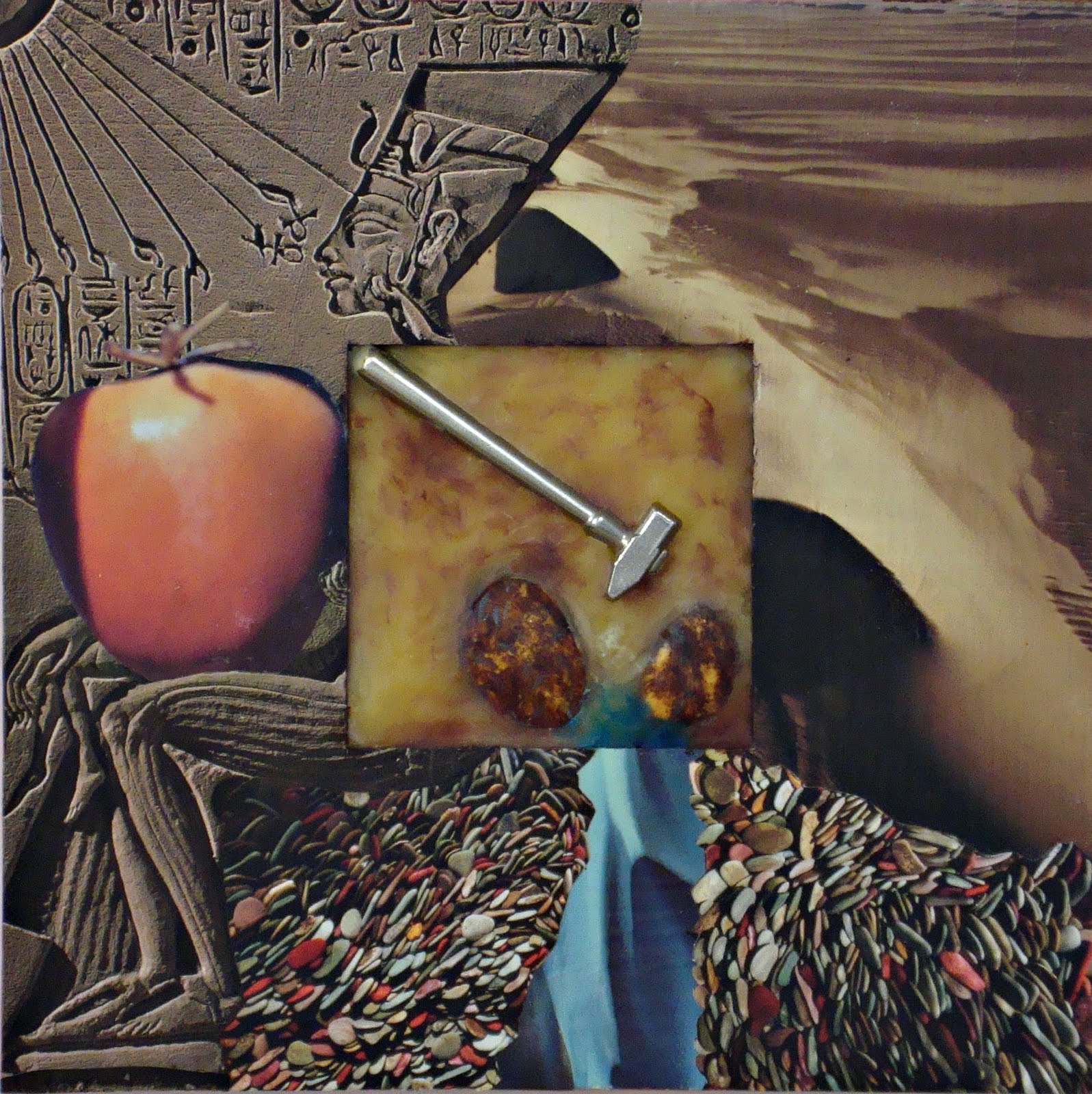
I am always on the lookout for inexpensive alternatives to stretched canvases as backings for my collages. I came across some interesting, and cheap, 10" x 10" wooden frames with recessed  mirrors in the center at IKEA and used twelve of them to create a series centering on key incidents found in Genesis-Joshua, before the Jews settled in the promised land.  The scripture references are given with the titles in case you wish to look up the relevant Bible passages.

Mail Order Bride (Genesis 24)

Highway to Heaven (Genesis 28:10-22)

 Night Wrestling (Genesis 32)

 Bushfire (Exodus 3)

All Decked Out (Exodus 28 & 39)

Calf Casting (Exodus 32)

 The Big 10 (Exodus 34)

 Encamped (Numbers 2)

Twice Struck (Numbers 20)

  Sympathetic Healing (Numbers 21)

  A Memorial Forever (Joshua 4)

“And Blow Your House Down”  (Joshua 6)

Monday, August 2, 2010

David and Bathsheba

The fascinating and perplexing story of this love triangle is narrated in II Samuel 11.  Interestingly, there are many parallels between this story and Nathaniel Hawthorne's The Scarlet Letter. In both, an apparently godly man of prominence in the community has a secret affair with a married woman resulting in a child. He admits his guilt publically at the end of the story. In Hawthorne's novel, each of the main characters is missing one key component of a balanced personality. In the case of Pastor Dimmesdale it is the will, Hester is short on intellect, and her husband Chillingworth shows little emotion. (An alert reader will see the same deficiencies even more obviously in Dorothy's friends in The Wizard of Oz.)  Hawthorne may have deduced these character flaws in the original Biblical account since it is obvious that David's problem is indeed a will too weak to resist temptation, and Uriah does seem to be lacking in emotional content.  Bathsheba is somewhat of a cipher, and we don't know if her actions result from the cold calculations of a scheming temptress wanting to better her situation, or just reflect someone willing to "go with the flow" of events.

Each 12" x 16" collage in my 2007 triptych pictured below centers in on one of the three personalities in a somewhat cartoonish fashion.


David

David's dual nature is clearly pictured here.  This story presents a powerful lesson in sincere repentence followed by God's forgiveness.  Some people have a major problems with the fact that David is called "a man after God's own heart" despite his adulterous behavior and subsequent cover-up.  In addition to the obvious observation that all human beings are sinners, I found some comments of  C. S. Lewis helpful in this regard. He categorized sins into two types: carnal and spiritual.  The former sins (such as lust, gluttony, drunkenness, etc.) only lead people to become more like a beast. In contrast, "spiritual" sins (such as spite, envy, idolatry, etc.) are much more dangerous since they cause one to become more demonic.  David's sins, unlike those of his predecessor King Saul, were carnal in nature. It should also be pointed out that the rest of David's career as king will be overshadowed by personal tragedies in his own family, beginning with the death of his son with Bathsheba.  Sin, even when completely forgiven, is still accompanied by inescapable consequences.


Bathsheba

Bathsheba is pictured as a literal "bathing beauty" along with others.  The inner workings of her mind remain as much a mystery as those of Mona Lisa.


Uriah

Uriah is pictured as the soldier par excellence.  His whole world is the army, and duty is his highest calling. One wonders whether there is any room left in his life for his spouse.