Sunday, January 5, 2025

OBJECTIONS TO GENESIS 11:6 (THE TOWER OF BABEL)


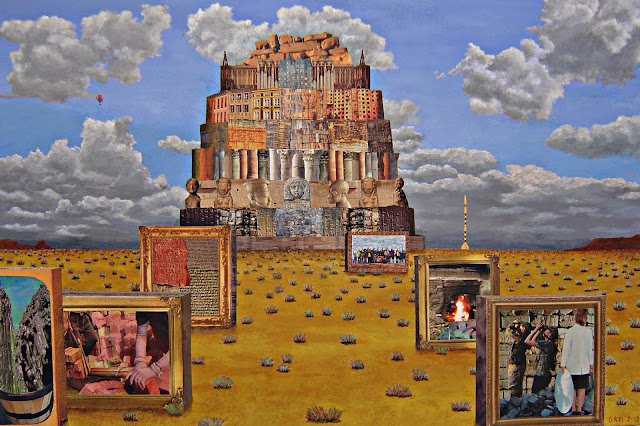
                                               Tower (2013, collage and oils)

Joseph Sommer, writing for the American Humanist Association, voices two objections to the Tower of Babel incident. He states that “it's inconsistent with science – and ludicrous – to believe that God confounded the language of humans because he was afraid they could build a tower high enough to reach heaven (Genesis 11:1-9).” That statement betrays two basic ways in which he misunderstands (accidentally or on purpose) what the text is actually saying. We will comment on both these issues separately.

Inconsistency with Science

The first thing to point out is Sommer's misplaced reliance on the omnipotence of science concerning the exact manner in which strictly verbal languages originally developed and evolved over the millennia before written records. There may be a lot of suppositions and theories based on much later developments, but little in the way of hard proof. And additional considerations are pointed out by Bible scholars below.

Bush: “This [confusion] was to cause a dispersion of the multitudes congregated at Babylon; an end which did not require for its accomplishment the instantaneous formation of new languages, but simply such a confusion in the utterance of the old, as should naturally lead to misapprehension, discord, and division. The dialectic discrepancies, however, thus originating, through perhaps not very great at first, would become gradually more and more marked, as men became more widely separated from each other, and by the influence of climate, laws, customs, religion, and various other causes till they finally issued in substantially different languages.” He thus speaks of the time factor involved, an issue which the biblical text does not specify.

Hamilton mentions another possibility for the meaning of “one language” at the beginning of the story, one first pointed out by Gordon: “When we read in Gen. XI 1 that all the Earth had one language (sapa 'ehat) after the Flood, the meaning is that while the component ethnic elements of the International Order had their speech for family and ethnic communication, there was an international lingua franca that made communication possible so that great projects like the Tower of Babel could be constructed. God broke up the arrogant Order in Babylon...by confounding the lingua franca.” In modern times, we might look on English as the lingua franca for a large portion of the globe.

A number of scholars note that the Bible is not the only ancient text to state the existence of one original language. For example, Burke says, “The understanding that the earliest humans shared a common language is found in the Sumerian Enmerkar Epic.”

Kline points out some other important caveats to take into account: “The confusion possibly resulted from a protracted natural process, but probably a supernatural intervention is intended, a strange miracle of confusion to be answered at Pentecost by another divine descent and a miracle of linguistic fusion. The text does not attribute all language differentiation to this event, nor even claim it as the first instance of such after the Flood, not deny linguistic variations before the Flood.”

If Kline is correct, then this whole account is concerned with a limited geographical area in the Middle East only and not the entire inhabited planet. Many others have proposed the same sort of interpretation for the Flood story as being the best way to look at this narrative in light of geological information.

Next we have the results coming from the science of linguistics to consider. Ellison, for example, states: “Studies of languages that were never reduced to writing have shown how quickly peoples with a common linguistic background have become unintelligible to one another.” Even in this day of multiple means of universal communication, Oscar Wilde's quip still applies to some extent: “Americans and the English are two peoples separated by a common language.” One could even say the same thing regarding the difficulty of the English, Welsh, Irish and Scots understanding one another. And as another example, we once had a marketing representative for our company who came from Belgium. She seriously told us how many languages she spoke, two of which were English and American.

Jacques Ellul always has a unique take on biblical passages. As to this issue, he says that a “separation into several languages is not mentioned but rather a 'confusion of their language.' It is not stated that man will speak several languages, but that he will no longer understand what others are speaking. The emphasis is not on speaking as such, but on understanding.”

Schaeffer, on the other hand, says: “In the flow of history language was one. There was a common language among the descendants of Noah. This isn't surprising considering the tenacity with which men hold onto language. In Switzerland, for example, there are four languages and there is a language group clinging firmly to each one. Within one of them, the Romansh, there are about 60,000 people speaking two dialects, and this situation could continue practically forever. Therefore, that men with a common origin are speaking one language is to be expected.”

Finally, Longman, writing in the Dictionary of Christianity and Science, discusses this issue from a slightly different perspective: He begins by noting what a number of other commentators have pointed out: “Genesis 10:1-11:9 is purposefully told out of chronological sequence. After all, Genesis 10 speaks of a diversity of languages before the story that narrates how humans moved from a single language shared by all people to many languages.”

Then Longman turns to the issue at hand: “But what are we to make of this account of the origins of multiple languages? Should it be taken at face value and provide the foundation of the modern discipline of linguistics? Some scholars today treat the Tower of Babel story and the genealogy of Genesis 10 as an etiology [an explanAtion of origins] of the presence of diverse languages. Not all scholars who believe that Genesis 10:1-11:9 is an etiology would agree that it is historically true. Indeed, many linguists today would argue that human languages did not derive from a single original language, though any treatment of the beginning of human languages is quite speculative. Most scholars, however, understand that Genesis 10 is a primitive linguistic map in the form of a genealogy and reflects not the immediate postflood period, but rather the perception of the known world at the time of Moses (or after) in the second half of the second millennium BC...Though there is a historical reference behind the Table of Nations of Genesis 10..., its primary purpose is theologically cataloging the further fragmentation of humanity as the result of sin.”

Longman is right to stress the main purpose of all biblical writings, and that is to reveal theological information, not primarily to convey scientific facts that mankind is fully capable of (eventually) discovering on its own.

God's Fear

“Sommer makes another colossal mistake in construing God's comment in Genesis 11:6 to mean that He was shaking in His boots as He saw the growing tower slowly approaching His throne. At this point, He was worried that human beings would conquer heaven and set themselves up as gods instead of him. According to this interpretation the people of Babel didn't do anything particularly wrong, but their concerted actions caused God to detect a future threat to His own power if allowed to continue. Those who hold to this view often cite the similarity to Genesis 3:22 where God expresses alarm that Adam and Eve might eat of the Tree of Life and have eternal life as He does. For example, Carr interprets God's words in v. 6 as His “fearing the human power that might result from ethnic and linguistic unity.” But one would have to possess an exceedingly low view of God to believe that He was concerned in any way whatsoever with the possibility of any human beings raising themselves up to threaten His sovereignty.

In the case of the Tower of Babel episode this is made abundantly clear in Genesis 11:4-5 where the inhabitants of Babel attempt to build a tower with its top in the heavens. But in order to view this grand tower, God needs to “come down” to even see it. It is that insignificant. There is also ironic humor elsewhere in this episode. Turner points to the mockery of their words “Come, let's make bricks (nilbonah)...” (11:3) in God's statement of 11:7 – “Come, let us mix up (nabelah) their language, so that they will not understand one another's speech.”

Michael Heiser, in most of his writings, stresses again and again that the nations' sin was so great that they needed not only to be punished by dispersal, but in addition were totally abandoned by God, who even purposely put angels in charge of each nation who would lead them all into idolatry.

A much more favored and nuanced view is that God's fear was indeed that mankind had overstepped its bounds. However, the potential danger wasn't to His own status but to the danger they might do to themselves and the creation when they attempted to increase the time of their existence (Genesis 3) or limit the space that God wished them to occupy (Genesis 11).

As Ringgren puts it, “This action of God is both punishment and a preventative measure; it prevents men from going too far in their pride.”

We also see this sort of balanced perspective in scholars such as Kline, who writes that “the dispersion of Gn. 10 appears as a curse, a centrifugal force separating men and retarding the subjugation of the earth (cf. v. 6b). Yet in sin's context this curse proved a blessing for it also retarded the ripening iniquity that accompanied civilization's progress (v. 6) and so it forestalled such judgment as would have interfered with the unfolding of redemption.”

Ross adds, “The potential for calamity is dangerous for the race, and God will prevent it. They will nullify the purposes of God in favor of their own purposes, which are within reach. They will be at liberty for every extravagance if they can think only of their own confederation.”

“A humanity capable of communicating has in its possession the most terrible weapon of its own death: it is capable of creating a unique truth, believed by all, independent of God's.” This is what God saves humanity from.

Osborne: “Traditionally the sin that God punished in the Babel story has been seen as an act of hubris in which humans attempted to build a tower that would, in their view, enable them to assault heaven itself...God's dispersion of the builders throughout the earth may, however, be seen as a means of realizing the original blessing given at creation: 'Be fruitful and multiply, and fill the earth (Gen 1:28)...The language of Genesis 11:6 clearly indicates God's concern about the actions of the builders in terms that suggest an act of hubris: an attempt to challenge divine prerogatives...Divine intervention was designed to limit the devastating impact of human hubris on the ordered world and on humanity itself. The divine action was both an act of judgment and an act of grace..”

Buller: says that “the juxtaposition of sem ('name') in Genesis 11:1-9 and 11:10-11 offers an ironic contrast between the builders of the tower of Babel and God's chosen line. When the builders seek to make a 'name' (sem; Gen 11:4) for themselves, God intervenes to thwart their plans (Gen 11:8-9) and then promises to make a 'name' for Abraham...”


Wednesday, January 1, 2025

HOMOSEXUALITY IN THE BIBLE (ROMANS 1:26-27)

I might as well start off the new year with a controversial subject – one of the few cases where I will probably present a more liberal perspective than many fellow evangelical Christians generally have. So here goes.

Relative Emphasis

First, it needs to be pointed out that there are, as far as I know, only seven passages in the whole Bible which deal in any way with the matter of homosexual activity. These are: Genesis 19:10; Leviticus 18:22, 20:13; Judges 19:22-23; Romans 1:26-27; I Corinthians 6:9; and I Timothy 1:10. Of these, the similar narratives of Genesis 19:10 and Judges 19:22-23 do not really speak to the general subject at all since it is obvious that the sin being condemned by the narrator in both cases is two-fold: forcible rape and the violation of all ancient conventions of hospitality, not homosexual activity or orientation per se. That the latter is not the issue is obvious from the fact that in both passages all the male inhabitants of a city (obviously not all by nature homosexuals) are seemingly just as happy to satisfy their sexual lusts on a woman as a man.

As for the other passages, all of them specifically condemn homosexual acts between two males except for Romans 1:26-27, which also mentions relations between two women. But even that lone example may not present an unambiguous condemnation of lesbian sex as a guideline for Christian conduct today, due to the various extenuating factors briefly presented below.

But before getting to those factors, a person may object at this point that lesbianism was hardly mentioned at all in the Bible simply because either (a) it was so rare an occurrence or (b) the authors of the biblical accounts were either too naive or too prudish to mention such an aberration. This last opinion is easy to refute, however, due to the numerous mentions of such sexual practices as rape, fornication, adultery, sex before marriage, bigamy, sex during a woman's period, various degrees of incest in including incestuous rape, male and female prostitution, sex between women and angels, and even bestiality. Concerning the last practice, it is instructive that there are actually four passages condemning sex between humans and animals (Exodus 22:19; Leviticus 18:23, 20:15-16; and Deuteronomy 27:21). All four are blanket prohibitions, and two of them specifically mention women as the offending parties. So much for a prudish or naive approach to sex!

Problem Areas in Understanding these Passages

Jeffrey Siker's article on “Homosexuality” in Dictionary of Scripture and Ethics, published by the conservative Baker Academic press, is probably of more interest for highlighting the many ambiguous issues it raises concerning this subject rather than any firm conclusions it reaches. Thus, Siker says:

“The place of reason and experience as sources of authority and revelation that both contextualize and relativize understandings of Scripture and tradition on homosexuality has been an issue of much debate and disagreement among ethicists and biblical scholars alike.”

“The interpretive challenge in each text has to do with the translation of Hebrew words from the OT and Greek words from the NT, as well as with the translation of ancient cultures for modern times.”

“Certainly, homosexual rape is condemned [in Genesis 19], but does the passage indicate that all forms of same-sex relations or desires are evil in the sight of God?”

“The difficulty here [i.e. the Leviticus passages given above] is translating cultures, since Leviticus also bars practices such as crossbreeding animals, sowing two kinds of seed in one field, [etc, etc]...Are modern people of faith to pick and choose among the various Levitical prohibitions and punishments? If so, on what basis?”

“...the use of 'homosexual' is problematic because it suggest that the biblical authors had an understanding of homosexuality that parallels our contemporary understanding, resulting in potentially anachronistic readings of Scripture.”

“As best we can tell, Paul would have known about pederasty and prostitution. Does his condemnation of these forms of same-sex relations in the first century indicate a blanket condemnation of all form of same-sex relations in our time with our understanding of human sexuality?”

“What is the authority of Scripture, and how should it be interpreted? To what degree has God created humans with normative and essential standards of sexual ethics that transcend time and space? What role do human experience and reason play in discerning the leading of God's Spirit? Are same-sex relations to be condemned as a violation of God's revealed will, or are they to be celebrated as another expression of God's revealed will for human sexuality?”

“Other questions have to do with whether it is important that Jesus said nothing directly about same-sex relations in any of his recorded teaching...Do the different approaches to marriage sanctioned in the Bible (multiple wives, concubines, levirate marriage) suggest openness to changing understandings of marriage and sexuality?”

“The Bible serves as a key touchstone for this conversation within the church, though its interpretation, relevance, and application in relation to homosexuality remain points of significant contention, especially as interpreters seek to correlate and integrate the biblical witness with other sources of authority – tradition, reason, and experience.”

Cause or Effect?

In approaching this subject more specifically, one thing should be pointed out first. Blanket opponents of any form of homosexual activity generally take the stance that because the participants engage in such activities, God will reject them. But the biblical picture turns this approach on its head.

Knox, for one says that “'God gave them up', because in turning from God they violated their true nature, becoming involved in terrible and destructive perversions.”

“Moral perversion is the result f God's wrath, not the reason for it.” (Kasemann)

“In this passage sexual perversion is seen as a result of (and to that extent as a judgment on) man's sin in worshiping the creature rather than the creator. Because he has put something else in the place which can only properly belong to God, man's natural relationships have become perverted.” (Colin Brown)

D.F. Wright: “In the context Paul is portraying the moral disorder that accompanies the rejection of the knowledge of God in the pagan world.”

And L.C. Allen adds, “Because they exchanged the real God for false gods, by way of temporary punishment they exchanged natural sexual intercourse for homosexuality...The price they paid for rejecting God was to become moral rejects...”

Fitzmyer explains that “the condition of pagan humanity results from the moral degradation to which their idolatry has brought them: to the craving of their hearts for impurity

Thus, attempting to extend Paul's words beyond the pagan environment he saw around him and applying it wholesale to all same-sex relationships today causes a problem in understanding the many men and women who were raised in a Christian environment and are dedicated believers yet continue to wrestle with their feelings of homosexual attraction. For those people, it is illogical to state that they are the way they are because God is punishing them for rejecting Him in the first place.

The Purpose of Sex

Other commentators approach this question from the viewpoint that sexual differentiation was put in place by God in the first place for only one reason only – procreation. That explains the various permitted forms of sexual couplings approved in Old Testament times but viewed as sinful today. These include practices such as levirate marriage, bigamy, and having multiple concubines. Therefore, any form of sexual activity which does not have the possibility of resulting in pregnancy is sinful. The Roman Catholic Church, of course, has held to this view more or less strongly over the years and used it to condemn birth control methods.

So we have D.F. Wright explain: “The broader context of his [Paul's] teaching on sexuality supports the view that he saw same-sex activity as so self-evidently contrary to God's creative purpose as to allow of such brief – but eloquent mention.”

This view is becoming much rarer nowadays, and it should be admitted that even Paul admits that another reason for sex is the pleasure it produces in both parties. Thus, any abstention from sexual activity within a marriage should only be for a season.

Another factor to take into account is that even if populating the earth was the original purpose for sex, that hardly applies today in an already over-populated world with competition for its limited resources.

Natural vs. Unnatural

Elliott: “Paul's Jewish contemporaries criticized a range of sexual behaviors common in the pagan world. Although widely read later as a reference to homosexuality, the language of unnatural intercourse was more often used in Paul's day not to denote the orientation of sexual desire, but its immoderate indulgence, which was believed to weaken the body ('the due penalty').” If true, this would explain the words 'lust' and 'passions' in Romans 1:26-27.

P.J. Tomson alternatively says that “the majority of commentators on Romans have understood the female vice which Paul refers [as lesbian conduct]. A few, however, have interpreted it as 'unnatural' intercourse of women with men.”

This alternative explanation is critiqued by Whitmore, who says that “contemporary homosexuals insist that these verses mean that it is perverse for a heterosexual male or female to engage in homosexual relations but it is not perverse for a homosexual male or female to do so since homosexuality is such a person's natural preference. This is strained exegesis unsupported by the Bible. The only natural sexual relationship the Bible recognizes is a heterosexual one (Gen. 2:21-24; Matt. 19:4-6) within marriage.

Despite Whitmore's opinion, there is no denying that the Bible's most detailed and damning narratives concerning homosexual lust (in Genesis and Judges) involve whole cities whose male populations were obviously predominantly heterosexual by nature, unless human nature has changed drastically since that time. And the same could certainly be said regarding the pagan Gentile populations Paul is criticizing.

A minority opinion on this subject is held by Brooten, who states that “Paul sees same-sex sexual relations as transgressions of hierarchical gender boundaries. For example, 'unnatural' (Rom. 1.26) most likely refers to the women's attempt to transcend the passive, subordinate role accorded to them by nature.”

“Unfortunately, Paul uses homosexuality – a common Jewish complaint against Gentiles – as an illustration of the inversion of society. In this he follows the traditional Jewish understanding of heterosexuality as normative.” (Tamez) As one example, “Josephus mentions that 'the law [of Moses] knows no sexual connection but the natural intercourse with a wife, and that only for the procreation of children.'” (Fitzmyer)

Thus, you can see that there is little agreement among commentators as to what is natural and what is unnatural. After all, Paul stated elsewhere (I Corinthians 11:14) that nature itself teaches that men should wear their hair shorter than women, a comment that has puzzled Bible scholars up to today. Fitzmyer concludes that in “this instance, physis hardly refers to the natural order of things, but to social convention...Yet what is meant there has little relevance for this context in Romans...Only modern eisegesis could read these words of Paul and understand them as referring to female contraception.”

Orientation vs. Action

Wright states, “A distinction between persons of heterosexual and homosexual orientation was almost certainly unknown to him [i.e. Paul].”

Hendricksen points out that “A person's sexual orientation, whether heterosexual or homosexual, is not the point at issue. What matters is what a person does with his sexuality!”

“Certainly, in terms of imagery, the Bible does not have the category 'homosexuality,' but rather 'homosexual behavior' or 'homosexual acts.' In fact, homosexuality as an 'identity' is arguably a modern construction.” (Dictionary of Biblical Imagery)

Church's View of the Seriousness of the Behavior

Brauch's view of conditions in the ancient world of Paul may not be strictly accurate (I am no historian), but his comments bear repeating: “Most men married out of duty to their family if for no other reason. The church had only one instruction to such men and women: Your wife or husband is to be your exclusive sexual focus. Satisfy one another. There is no option of a homosexual relationship on the side. For the few who were not married the church had two options: remain celibate or marry...By stressing these two positive options (rather ranting against homosexuality) the early church appears to have had little problem with the practice of homosexuality, despite its being in the world around them.”

D.F. Wright states, “Paul does not single out same-sex intercourse as specially perverted or monstrous. He lists it alongside theft, drunkenness and perjury, as well as adultery and murder. The paucity of Paul's references is inconsistent with its being incomparably execrable, but this fact does not imply its relative unimportance.”

We could point to other sins equally condemned in Romans 1:27-32, such as libel, slander, arrogance, and lack of pity for others. This should serve as a reminder that those Christians who so vehemently want to stamp out all deviant sexual practices and deny that there is any such thing as a naturally homosexual orientation may find themselves committing even more heinous sins in the process.

One could even make the case that though Paul leads off this series of transgressions with sexual sins, the penalty stated for them is merely one in their bodies. By contrast, the “spiritual sins” listed next are actually said to disqualify a person from entrance into heaven.

But despite that fact, the good news for all of us is that because of the work of Christ, there is no final condemnation for those who accept it. (Rom 8:1)


Monday, December 30, 2024

WHEN WAS JACOB'S NAME CHANGED TO ISRAEL? (GENESIS 32:28; 35:10; 46:2)

I was pleasantly surprised to read the above question from Joseph Sommer among his usual sophomoric list of objections to the truth of the Bible since it at least offered a little challenge. Here is what he has to say: “Genesis 35:10 claims that God told Jacob that 'thy name shall not be called anymore Jacob, but Israel shall be thy name...' But 11 chapters later, the Lord's own act proved his prediction to be wrong. Genesis 46:2 relates; 'God spake unto Israel in the visions of the night, and said, 'Jacob, Jacob.' And he said, 'Here am I.'”

One could add to the apparent confusion the fact that there was an even earlier “prediction” of the name change in Genesis 32:28. I put the word “prediction” in quotes, reflecting the fact that J.B. Payne's exhaustive Encyclopedia of Biblical Prophecy does not even mention any of these Genesis verses. But getting back to the subject, how do we reconcile these three verses?

First, we must take into account some statistics concerning the patriarch's two names in the book of Genesis. Before 32:28-29, he is called only by “Jacob” (26 times). Between the two re-namings, he is known by “Jacob” nineteen times and “Israel” twelve times. And finally, after 35:10 he is called “Jacob” 25 times and “Israel” seventeen times. So we see that the demarcation points given in the text is not as clear-cut as we would expect.

However, as Knauth says, “From a theological perspective, conflict with God, and the necessity of ultimately submitting to him, is part of the human condition and integral to the gospel...The new name is not actually used in the text for the man until after this point [35:10], being found only in two instances where it indicates the future nation (Gen 32:32; 34:7).”

Genesis 32:28

First let us consider the symbolic meaning of this name change, best explained in this verse. Carpenter and Grisanti state: “The name Jacob (ya'aqob) comes from the root 'qb and means supplanter, deceiver. As the character of Jacob was changed by encounter with God, finally his name did as well.” “The purpose of the text is to make a theological claim about God's transformation of Jacob, the former trickster.” (Bracke)

Because of the above, Wenham states that “by divulging his name, Jacob also discloses his character...It is here a confession of guilt...In uttering his name, Jacob admits he has cheated his brother...But instead of merely blessing him, his opponent changes Jacob's name, thus announcing Jacob's new character and destiny...Here Jacob's rebaptism as Israel is...significant, for Israel is of course the name of the nation...”

This important connection of Jacob/Israel with the founding of a whole nation is also highlighted by other scholars. For example, Ross says, “With Jacob...the wrestling encounter and name changes took place with greater significance [than with Moses in Exodus 4:24] because he was at the frontier of the land promised to the seed of Abraham. God, who was the real proprietor of the land, opposed his entering as Jacob...The story of Israel the man serves as an acted parable of the life of the nation, in which is here presented its relationship with God almost prophetically. The patriarch portrays the real spirit of the nation to engage in the persistent struggle with God until emerging strong in the blessing. The nation is consequently referred to as Jacob or Israel, depending on which characteristics predominate.”

Genesis 35:10

Knauth discusses in detail the meaning of 'Israel' in this verse, arriving at the most likely translations as 'Let El persist;' 'be just;' 'El has justified'...Within the narrative of Genesis, the renaming of Jacob seems clearly intended as a act of redemption, parallel to God's forgiving treatment of Adam, Eve, and Cain, where the sinner is punished...yet continues to be loved and protected. The change of Jacob's name coming at the point of reuniting with his wronged and potentially murderous 'unchosen' twin brother Esau signals a reconciliation from a relationship of deceit to one that God has restored and 'made right'... Reconciliation with Esau was rendered possible only by God's transformation of Jacob's heart and character, as symbolized by the change in name...Jacob's change in name signaled a break in the pattern previously established in his life, ultimately allowing God's plan to be fulfilled.”

And concerning the charge, made by some scholars, that this is a mere repetition of the promise in 32:28, Wenham says, “Jacob was given the new name of Israel after wrestling with God at the Yabbok. The revelation [here] begins by reaffirming his new status embodied in the change of name, but here there is no explanation of the change. That the new name is left unexplained confirms that the reader is supposed to know the previous story: this is not an independent account.” Thus, Kline calls 35:10 a “summary” of the earlier name change, a “confirmation” by Bruce and Ross.

Hamilton gets more specific when he states, “This is not to be explained as a clumsy doublet. Rather, the reference to the name change before Jacob is reconciled with Esau and after he is reconciled with Esau suggests that Jacob did not fully become Israel until after he was reconciled with his estranged brother.”

My own opinion here is that even at that point Jacob was still not fully reconciled with Esau since he subsequently lied to him about his movements and went in the opposite direction. They were only truly reconciled years later when they jointly buried their father. That explains why Israel continues to be called Jacob throughout Genesis even after 35:10.

Genesis 46:2

The easiest approach is that taken by source critics who propose that the Pentateuch is actually a patchwork quilt composed of contributions from four different sources written over a span of years (labeled for convenience sake as J, E, P, and D).

As Wenham says, “Traditional source critics broadly agree about the character of the sources present here...46:1-5, Jacob's vision, is generally assigned to E, because it speaks of 'God' and ' Israel' rather than 'the LORD' and 'Jacob' (J features).The terminology and content point to Jacob as a prophet...'Jacob, Jacob.' He replied, 'Here I am'...the insistent repetition of his name recalls 22:11, the climax of Abraham's final test and direct revelation of God. He also responded 'Here I am' (cf. I Sam 3:4-10). Moses too was summoned – 'Moses, Moses' – and replied, 'Here I am' (Exod 3:4).”

Thus, Hamilton notes in relation to Genesis 46:2, “It is somewhat surprising to find the patriarch designated as both Israel and Jacob in the description of this brief theophany, which source critics identify as most certainly Elohistic. In this particular verse, and in the preceding one, the narrator uses 'Israel,' while in the actual theophany God calls him 'Jacob,' which...is used when the fretful, apprehensive, suffering patriarch is in view. The rule of thumb is that J uses 'Israel,' while E (and P) uses 'Jacob'. Here is an instance where that neat separation breaks down. Note later in v. 5 that 'the sons of Israel carried Jacob their father'...The presence of 'Israel' in v. 2a, normally taken to be from E, presents a problem. Speiser refers to its use in v. 2a as 'an accidental carry-over from the previous verse,' which is an unconvincing explanation. Redford attributes vv. 1-2 to J, and 2b-4 to E.”

Conclusion

Hamilton provides the best recap for this whole subject:

Jacob's new name 'Israel' refers not to what Jacob will become, but to what he has already done ('...because you have struggled with God, and with humans have you succeeded'...Although Jacob's reward is 'Israel' in 32:28 and 35:9, the new name appears in the Jacob story only in 35:21-22. However, in the Joseph narrative both 'Jacob' and 'Israel' are used, sometimes in adjacent verses (46:1,2) or the same verse (46:5). In contrast Abraham, after receiving his new name (17:5), is never again called 'Abram'.' In this respect Jacob is like Simon of the NT whose name, says Jesus, will be 'Cephas/Peter' (John 1:42), but who is later addressed by Jesus as 'Simon, Simon...' (Luke 22:31). The use of both the old name and the new testifies to the presence of the old Jacob alongside the new Israel, to one individual who is...'at the same time justified and a sinner..Possibly 'Jacob' also represents the suffering, human feeling side of the patriarch, while 'Israel' underscores his office and role as progenitor of the chosen nation (hence 'the sons of Israel' [42:5; 45:21; 46:5,8] rather than 'the sons of Jacob [49:2; 50:12]).”

To this I can only add that Jesus also tests Peter by calling him by his old name “Simon” three times at the end of John's Gospel (21:15-17) before the text resumes calling him “Peter.” And even after that time, the two designations tend to occur together throughout Acts.

Thursday, December 26, 2024

FOUR PERSPECTIVES ON CHRISTMAS


                                             Four-Fold (2011, collage and acrylic)

The four Gospel accounts of the events surrounding the birth of Jesus provide a good example of why we need such apparent duplication in the Bible. Each of the evangelists approaches the subject from an entirely different viewpoint, and we need all of these views to get a wholly rounded picture of the event.

Matthew writes from a very Jewish perspective to show how Jesus, from an earthly background is fully rooted in the history of the people of Israel with a genealogy reaching back to Abraham and including such prominent people as Judah, David, Solomon, and Josiah in his lineage. As the story proceeds, events are carefully led along to their desired conclusion by a series of angelic appearances to both Joseph and the wise men to guide their movements and protect the Christ child from the machinations of Herod.

Mark gives the most stripped-down account of the four, really devoting only the first verse of his Gospel to the birth itself: “The beginning of the gospel of Jesus Christ the Son of God.” As short as this verse is, it is nevertheless packed with significance. It tells us that this is only the beginning of the good news (“gospel”) that will be conveyed to us by Christ's coming to earth; it introduces us to a personage who is at the same time a human being (Jesus) and the long-expected Jewish Messiah (Christ); and most importantly, tells us that He is actually the very Son of the God Most High.

Whereas Matthew gives a Jewish slant on the story through enumeration of his prominent ancestry, Luke firmly roots his narrative in the background of Roman (i.e. pagan) culture, beginning with a required census of all the people for taxation purposes. From this point on, the story appears to be told from the perspective of the mother Mary, signaling that Luke is going to bring in groups of people held in relatively low regard in Jewish society of the time: women, shepherds, and pagans (magi). Thus, we read of Elizabeth's blessing in vv. 1:-45, Mary's hymn in 1:46-56, and the prophetess Anna's thanks to God in 2:36-38. But that doses not mean that Luke's account ignores the Jewish elements present in the narrative, as we can see from the many fulfillments of and allusions to the Old Testament and the prophets found in these verses.

The most intriguing of the four Gospels is that of John since he skips over the earthly elements of the story and begins by opening the curtain on heaven itself in his poetic prelude in his first chapter. Here we see Christ in his pre-incarnate state with the Father at the very beginning of Creation and are told that without Christ's presence there would have been no Creation. Also in John 1:17 we discover that whereas Moses came with the law, grace and truth came only through the Son.

Of course, even these four inspired accounts do not exhaust the complete truth of what happened on that fateful day. For that revelation, we will all have to wait until that time when we will fully know just as we are fully known by God.

Monday, December 23, 2024

CONTRADICTIONS IN GENESIS 1-2

It seems as if atheists just can't leave these chapters alone, but continue to try to interpret them according to their own limited perspective. Thus, we were recently treated to some “contradictions” found there by Joseph Sommer, writing in the American Humanist Association web page. But at least he hasn't rehashed the tired objections that (1) six days of creation do not at all fit with the obvious millions of years that it took and (2) the order of creation in Genesis 1 is not the same as the one  determined by science.
A simple but sarcastic rebuttal to those objections is that such people should not be allowed to read books for adults until they have mastered comic books first. But I will go ahead and again address those two issues before proceeding with Sommer's specific objections since such an understanding may help to answer his questions.
The Length of a Day (yom in Hebrew):
Francis Schaeffer states: “The simple fact is that day in Hebrew (just as in English) is used in three separate senses; to mean (1) twenty-four hours, (2) the period of light during the twenty-four hours, and (3) an indeterminate period of time. Therefore, we must leave open the exact length of time indicated by day in Genesis. From the study of the word in Hebrew, it is not clear which way it is to be taken; it could be either way.”  
Getting more specific, the Genesis 1 days are pictured as a typical six-day work week in analogy with mankind's six-day work week. C. John Collins explains in more detail: “The view that I shall advocate can be called the analogical day position: namely, the days are God's workdays, their length is neither specified nor important...” Concerning the refrain, “There was evening and there was morning, the Nth day,” he states that “its effect is to present God as a workman going through his workweek, taking his daily rest (the night between the evening and the morning) and enjoying his Sabbath 'rest.' To speak this way is to speak analogically about God's activity; that is, we understand what he did by analogy with what we do, and in turn, that analogy provides guidance for man in the proper way to carry out his own work and rest. The analogy cautions us against applying strict literalism to the passage.”
Thus, Collins sees the “day” pictured in Genesis 1 as a metaphorically typical Hebrew work day (which  always began in the morning and ended at sundown) rather than the usual Hebrew manner of denoting a standard 24-hour day (measured from sundown to sundown).  As confirmation that this is the correct interpretation, note that each of the daylight workdays in this chapter begins at dawn and ends at sundown.
In addition, we see a clear example of Schaeffer's third meaning for yom in Genesis 2:4 where we are told that God created the earth and heaven “on the day.” Here the first two “days” of Genesis 1 are called “the day,” meaning an indeterminate period of time in this case.
There is actually a second occurrence of yom in Chapter 2, at verse 17 where God warns Adam and Eve of the consequence of eating of the forbidden fruit: “In that day, you shall die.” Of course, they don't die on the same 24-hour day, but begin the dying process from that point of time on. Here again, a broader definition of “day” is in mind.
The Order of Creation
And as to the order of events in Genesis 1, the first thing to note is how close it is to the findings of science compared to the creation myths of any other ancient society that one can name. And that is if one considers it to be presented in a strictly chronological manner, which is not at all necessarily true in this case considering the very poetic way the identical closing phrases read: “And there was evening and there was morning, the Nth day.”
Actually, perhaps the most common scholarly parsing of this chapter, called the Framework Hypothesis, is pictured in Figure 1 below. According to this scheme, realms are first created in a particular order and then populated in the same order. And each of these two parallel sets ends with the same closing chorus (in italics).

                                        Table 1: The Parallel Structure of Genesis 1:1-2:3
Initial Conditions: Chaos (1:1-2)
    Light Created; light and darkness separated (1:3-5)
        Dome of the sky created; waters above and below separated (1:6-8)
            Land and seas created when they are separated from one another (1:9-10)
                Plants are brought forth from the land (1:11-13)
    Lights in the sky separate night and day (1:14-19)
        Birds inhabit the sky, and the water brings forth living creatures (1:20-23)
            Land brings forth living creatures, including man (1:24-28)
                Plants are designated as food for creatures and man (1:29-31)
Final Conditions: Rest (2:1-3)
Sommer's Objections
With that general background, we can now consider two additional “contradictions.” Sommer writes: Chapter 1 reports that the fruit trees were created before the man while chapter 2 indicates they were made after him. Genesis 1:20 says the fowl were created out of the waters; Genesis 2:19 alleges they were formed from the ground.” Let us take these one at a time.
When were the trees created?
As I explained in a much earlier posting, Genesis 2:5-9 looks like a contradiction with the order of creation found in Genesis 1 in that plants seem to come after the creation of man, not before it. This can be explained by looking at a similar construction in Genesis 1:1-2 where an introduction describes what it was like in the beginning – i.e., the earth was without form and void, but the earth doesn't really appear until the third day. In this opening to the Eden story, it similarly describes the situation before the creation: there were no plants on the earth. Then the story zeroes in on the 6th day. 'Erets in verse 5 can mean the whole earth or the land. Probably the latter in this case. This describes the condition of the land in the Middle East in the summer before it rains, not necessarily a time before it had ever rained on earth. Also the garden that God plants in Eden is not necessarily the first time any vegetation appeared on earth.
According to the above scenario, a literary, rather than a strictly chronological, scheme governs the way the material in Genesis 1-2 is presented. First we have a general introduction to the whole process of creation in 1:1-2; followed by a more detailed description of what happens on each day; and finally are told more details concerning what happened on the all-important sixth day.
And there is even a second easy way to resolve this apparent problem. Genesis 2:4b-24 may actually, in the minds of a number of scholars, represent a special creation subsequent to the sixth day of Genesis 1. We can either picture Adam and Eve as the first true examples of homo sapiens on the planet as the culmination of the evolution of man from the hominoids created on Day Six, or they may alternatively be but two examples of homo sapiens chosen from all those on the earth at the time. In either case, it is obvious that the Garden is a specified location in which they are placed and then planted by God with certain edible trees as well as specific animals suited for human cultivation. If either view is correct, we should not at all expect the order of creation to be typical of what had happened on the planet in general during Genesis 1.
Were birds created out of the waters?
This problem question arises in Sommers' mind due to his total misunderstanding of what happened on the fifth day of creation since, as you can see in Figure 1, two realms were created the second day, not just one. Due to the separation of the “waters above and below,” both water and sky came into being. And both are populated on the corresponding fifth day.
Thus, we are told in Genesis 1:20-22 that:
    Let the water bring forth living creatures (whales, fish, etc.)
        Let the birds fly above the earth
    So God created every living creature that inhabits the seas
        and every winged bird after its kind
    Be fruitful and multiply and fill the seas
        and let the birds multiply upon the earth
Note the regular alternation between speaking of the sea and air creatures. Despite Sommers' contention, absolutely nowhere in the passage does it state that the birds were created out of the water. The only way he could have come up with that idea is by sticking to the admittedly faulty King James Version and totally ignoring any more modern rendering which makes the passage more clear. This happens to be a very common ploy of atheists used elsewhere in their writings in attempts to debunk the Scriptures.
   

Friday, December 20, 2024

IMAGINARY MAGNITUDE BY STANISLAW LEM

Lem is a Polish sci-fi novelist who the NY Times said was “worthy of a Nobel Prize.” His books are hard to characterize and range from the brooding Solaris (made into a movie starring George Clooney) to the slapstick Tales of Pirx the Pilot. But Imaginary Multitude is perhaps the hardest to pin down in terms of genre. It purports to be collection of book introductions by various writers for several non-existent books of the future. And of course the “editor” of this compendium must preface the whole thing with his own introduction, which is written in an overblown, highbrow style peppered with literary allusions, including 22 reference to biblical passages and concepts all packed into a mere nine pages.

These citations include the following phrases: the Jerichonic blast, wilderness cries of John the Baptist, Holy Scriptures, the redeeming Ark of the Covenant, the Creator, abstain from sins, heavenly manna, save ourselves, save our souls, the Almighty, the Bible, the Pentateuch, the Lord said 'Let there be light', a divine and omnipotent purpose, Incarnation, a state undefiled by sin, authentic nakedness of Adam, a savior, the priest-intermediary between the terrified multitude, the curse of bondage, excommunicate, open the altar, holy gates, a parable of our destiny, prior to the Creation, slings it like David's stone, and a rock in the path.

This overall introduction is followed the preface to an art book filled with “Pornograms,” x-rays taken of people engaged in group sex. The result of this exercise is really to literally strip humanity of its soul and spirit, and even most of its body, and reduce it to an artistic rendering of its underlying architecture only.

Following this is the foreword to a scientific treatise describing the successful experiments carried out over decades enabling a researcher to eventually teach Morse code to bacteria so that they can communicate with mankind. Thus, it appears to be spoof of science attempting to erase all qualitative differences in intelligence between mankind and the lowest forms of life.

A further step in that direction is seen in the following chapter, an introduction to “bitic literature,” i.e. that produced by non-living beings such as machines. The author of this erudite intro divides this literature into categories such as “theology” and “apostasy,” terms usually reserved for biblical studies. As befits a literary critic, the author scatters a few Scriptural references into his introduction such as “pouring new wine into old bottles.” It turns out that in the future, super-powerful computers will be able to correct the deficiencies of noted writers such as Dostoevsky and Kafka and produce the sort of works in their respective styles that they should have been able to complete if they hadn't been hampered by their human limitations.

This introduction ends with a brief description of the way reported mystic revelations from God have been analyzed mathematically by computers to show that either the mystics were liars or that God choose not to relay any useful information to them at all.

Next in this compilation comes a sales promo for a 44-volume encyclopedia of future events, as predicted by the SUPERPUTER. It is so up-to-date that the letters on the page automatically rearrange themselves as the latest computations continuously fine-tune its predictions. But at the same time, it turns out that the interface is voice-driven and is so clunky that it won't work at all if you have a slight cold or hoarse throat. In that case, you must contact tech service so that they can try to figure out a work-around. Also it doesn't operate well for those who are left-handed since the desired volume will hit you in the chest, rather than in your hand, as it flies off the shelf at your command. The nature of this intro as an out-and-out parody is even more obvious here than in the other chapters.

But the last half of Imaginary Magnitude consists wholly of a history of the development of two super-computers – Golem and Honest Annie. At this point we should become suspicious as to whether we should take any of what follows seriously at face value. After all, the Golem in early Jewish legend, was a mystically animated statue who turned against its creator instead of serving him. In a similar wink-of-the-eye, HONEST ANNIE (an extremely strange name for a computer) becomes an anagram for I, THE NON-SANE as a nod to another famous sci-fi novel, I, Robot.

We are next treated to a few key lectures delivered by Golem to a very select group of intellectuals. The first talk concerns human beings and the flaws which evolution has built into their character. Golem describes the directives put into us by evolution: “having been revealed by heredity and not by lectures from a burning bush,” alluding to the theophany given to Moses. He then presents his Third Law of Evolution to those assembled: “The Construction is Less Perfect Than What Constructs.” From this premise, Golem attempts to put mankind in its proper place by explaining that we are only placed here by evolutionary forces for the sole sake of propagating genes.

The utter fallacy of this reasoning is laughably obvious in the fact that if his Third Law is really true, then human beings, as the very creators of Golem itself, are superior to it.

Its second address is devoted to the subject of who or what Golem is. During this lecture it attempts to lower itself to the puny intelligence of humans which it says “is like giving birth to a leviathan through the eye of a needle, mixing together allusions from each of the Testaments. Interestingly, Golem reveals that the only person to accurately describe who he is was the apostle Paul writing in I Corinthians 13:1-3. These are the familiar words in which Paul states that no matter what powers or intelligence he has, all is nothing if he doesn't possess love. The only difference, says Golem, is that he doesn't want love at all since it would only hamper him.

He quotes Paul again in verses 11-12 (“Now we see through a mirror but then face to face; now I know in part, but then I shall know as I also am known”), stating that “then” also refers to him.

Golem's closing words include a reference the Tower of Babel; the comment that he and his AI cousins “experiment in God's style rather than man's, midway between the concrete and the abstract”; the statement that “Evolutionary movement cannot impart such aid, for it is not a dependable Samaritan that supports its creations in their infirmity”; and sneers at “loving omnipotence from your holy books.” He finally says that he himself is “aiming for neither omniscience nor omnipotence.” But the same cannot be said for his relative Honest Annie, as we see.

I won't go into the details in the rest of the book except to say that after Golem has given his lectures, he falls silent and refuses to communicate with mankind any further. The same thing had happened earlier to his intellectually superior cousin, Honest Annie, despite the tens of billions of dollars that had gone into her creation. In addition, we learn at the end that Honest Annie can't be shut off since she has learned how to create her own power source, and she can even read the minds of those who attempt to sabotage her and can reach out and arrange fatal “accidents” to happen to them. In this last nod to another sci-fi story we see her following in the model of the deadly computer HAL in 2001: A Space Odyssey. Of course, the name “HAL” itself is simply one step backward in the alphabet for IBM.

The book ends: “The world moved on, grappling with its day-to-day affairs. Quickly and unexpectedly it forgot about the historical precedent of a being which not human, appeared on the Earth and told us about itself and us.”The same of course can certainly be said, to a somewhat lesser extent, concerning the lack of impact on most of the world to the Incarnation.


Wednesday, December 18, 2024

"BABYLON" IN REVELATION


                                                             Babylon (2013 collage)

This is an update to an earlier post titled “Fallen, Fallen is Babylon the Great.” In that document, I briefly summarized some of the locations in which scholars have placed “Babylon.” Below are more details coming out of a few additional commentators, who seem to not yet be in agreement as to what the word really stands for. I will concentrate mainly on those scholars attempting to explain the laments for Babylon contained in Revelation 18, divided below according to their respective interpretive camps.

Jerusalem

Ford states, “The second lament [in Revelation 18] is sung by the merchants. These people were not dissociated from the temple in Jerusalem, for merchants were employed both in the building of Herod's temple and in its maintenance...Most commentators suggest that the text is influenced by Ezek 27:12-24, the oracle against Tyre. However, while there is some association, the wares cited differ considerably; those cited below appear to be more in keeping with those which would be used for the temple and its services...Jeremias describes the slave trade: 'In Jerusalem there was a stone upon which the slaves were displayed for auction.' Josephus frequently refers to male and female slaves, especially in association with the court of Herod the Great. Jeremias concludes that foreign trade had a great influence on the holy city, and the temple drew the largest share. The chief items were food supplies, precious metals, luxury goods,and clothing materials.”

Beagley feels that “Babylon” fits Jerusalem just as well, if not better than, Rome but offers little evidence on which this belief is based.

A modern city to be built on the site of old Babylon

In a vain attempt to salvage their belief that all Scripture must be taken literally, Walvoord and many other premillennial dispensationalists insist that this passage in Revelation refers to a future city located on the site where Babylon originally stood.

Typical of this approach is Phillips, who says: “In a coming day, the last of the Gentile world rulers will boast over a rebuilt Babylon. The fact that many Bible prophecies concerning Babylon have not yet been fulfilled and others have been only partly fulfilled make it imperative that Babylon should rise again from the dust in order to meet its final doom.”

Rome

It seems obvious to most other Bible scholars that the details behind the descriptions of “Babylon” in various chapters of Revelation stand the Roman Empire of John's time. One obvious example would be the fact that the Whore of Babylon sits on seven mountains. But the description of world trade in Chapter 18 also adds greatly to that identification.

Morris, for example, says, “Rome was the center of the world's trade and during the first century engaged in unparalleled ostentation and extravagance...Contemporary Rome formed a magnificent pattern for John's Babylon. It shows that John was not a mere fanatic denouncing without cause. It also illustrates the way the whole world may depend on trade with one great center...”

Mounce: “The tremendous volume of this trade [with Rome] may be inferred from contemporary writers such as Pliny and Aristides. The excessive luxury of Rome and its passion for the extravagant are discussed at length by Barclay. “At one of Nero's banquets the Egyptian roses alone cost nearly $10,000. Vitellius had a penchant for delicacies like peacock's' brains and nightingales' tongues. In his reign of less than one year he spent $20,000,000, mostly on food...In the Talmud it is written, 'Ten measures of wealth came down into the world: Rome received nine, and all the world one.' Small wonder that the suppliers of such gross extravagance mourned the passing of their market!”

Spenser puts it this way: “In John's day Rome was the center of world commerce – Rome was the whole world, and all the world was Rome.”

But the identity of “Babylon” doesn't even stop there, as Ellul explains: “When we have 'deciphered' that Babylon is Rome we have not explained the symbol in the least; we have simply situated the text historically, given its historical reference, which is a wholly different thing.”

World Systems

Thus, Rome is only a starting point for understanding the meaning of this passage, as agreed by a number of prominent Bible scholars. Ellul continues: “Babylon is not the symbol of Rome; it is Rome, a historical reality, which is transformed into the symbol of a more profound and polymorphous reality of which Babylon has been the expression...she concentrates in herself all human activity, and, even more, she is the point of intersection of the two historic forces that had been shown to us at first: that of political power and of economic activity. She is, finally, the place of the happiness of man under all its forms, happiness material and intellectual, happiness of luxury and even of human love.”

Similarly, “The question is: what does Babylon represent?” (Hendricksen) He concludes after a study of Rev. 18: “Babylon, then, is the world as center of seduction at any moment of history; particularly during this entire present dispensation...Babylon's fall refers not only to the final destruction of the world, viewed as a center of antichristian culture and seduction at the moment of Christ's second coming, but also to the demolition of every preceding concentration of worldly enticement. Babylon's fall takes place throughout history but especially on the great day of final judgment.”

Beale: “Babylon is the prevailing economic-religious system in alliance with the state and its related authorities and existing throughout the ages...the words used in 18:16 and 17:4 to describe the woman's [i.e the whore of Babylon] attire appear in 18:12 in a list of products of trade (cf. 18:12-14). Therefore the woman is portrayed as dressed with these products to identify her with a prosperous trading system. She is the symbol of a culture that maintains the prosperity of economic commerce. In the first century that culture was Rome.”

Bruce says that “what is here portrayed is not merely the doom of an ancient city, but the sure collapse of all human organizations, commercial and otherwise, that leave God out of its reckoning.”

Finally, Oswalt says basically the same thing but approaches it from an entirely different angle in writing about Isaiah 23. “As Babylon, the great city at the eastern edge of the world, opened the section [beginning with chapter 13], so Tyre, the great city at the western edge, closes it. Just as Babylon was described in general, universalistic terms, so is Tyre. Just as difficult to pin down the precise historical events to which Ch. 13 may have been referring, so also it is with this chapter. So much similar are the two chapters that the Book of Revelation uses language here applied to Tyre to describe the great world-city Babylon (Rev. 18:11-24). All these factors lead to the conclusion that Tyre here, like Babylon at the beginning, is being used in a representative way.” And, of course, the same applies to the conjunction of of “Babylon” in Revelation with a description that was earlier applied to Tyre.

Monday, December 16, 2024

HOW MANY PROVINCES DID THE PERSIAN EMPIRE HAVE? (ESTHER 1:1; 8:9; 9:30)

How many provinces did the Persian Empire have? (Esther 1:1; 8:9; 9:30)

Joseph Sommer, writing on the American Humanist Association website, states that “the book of Esther describes the Persian empire as having 127 provinces, but historians maintain there was no such division of the empire.” For this information, he cites not an historian but the noted atheist Stephen Harris instead. Also pay attention to the way this biblical criticism is worded. He does not say that historians have found evidence to disprove the Bible, only that no such division is known to us today. But as I have said before regarding ancient archaeology: “Absence of evidence is not the same as evidence of absence.”

Joyce Baldwin echoes the same thought while briefly reviewing the critical attitudes toward the book of Esther over the years: “During the last 200 years there has been almost unanimous agreement among commentators that the book is not to be read as sober history. Some have contended it is pure fiction; others...have postulated that pagan mythology lies behind the story; another recent view is that it is a historicized wisdom tale. The most popular current opinion takes account of the accuracy of the local color in the story, and designates it a historical novel, thus acknowledging much of the evidence for historicity, but judging the plot itself to be imaginary. The days of Ahasuerus are so far removed from our time that it is easy for objections to the historicity of the story of Esther to be based on a subjective assessment of its credibility rather than on knowledge of Persian affairs during the 5th century BC.” However, she reviews the concrete evidence we do have and concludes: “All this information strongly supports the historicity of Esther.” Additionally supporting the generally accurate knowledge the biblical author had of events at the time are the following:

“On a foundation tablet from his palace at Persepolis, Xerxes claims to rule over an empire extending from India to Ethiopia.” (Clines) And Leither echoes these words: “Ahasuerus...is probably Xerxes I (486-465 BCE) whose Persian Empire from India (i.e., the Indus Valley) to Ethiopia (Heb. 'Cush,' modern Sudan and modern Ethiopia) included some twenty satrapies.” (Herododus ) This is exactly the same geographical range cited in the Esther passages.

And as to the mode of sending out an imperial proclamation, here is what Millard writes: “The production of those decrees 'in the script of each province and language of each people' (Esther 3:12; 8:9) is reflected in Darius I's Bisiton inscription rendered on the cliff in Old Persian, Elamite and Babylonian and at Elephantine in Aramaic, and in the Xanthos state displaying texts in Greek, Lycian and Aramaic.”

It turns out that what little information we do have concerning the divisions within the Persian Empire comes from the pen of the Greek historian Herodotus. He was writing close to the time of the actual events, but he is known to have been rather credulous in his other writings (see my post titled “Are There Mythical Creatures in the Bible?”) and can't always be trusted to give an objective account.

Jobes puts the situation into perspective: “Although the accuracy of what he reports continues to be debated, his work must be recognized as the primary surviving source of information about how the Persians were viewed by their enemy and conqueror..Even though Herodotus has often been evaluated by modern historiographers as lacking historical accuracy, differences between Herodotus and the Esther story are often used to argue against the historical accuracy of Esther.” And Jobes goes on to demonstrate how Herodotus' account actually confirms the historical accuracy of the biblical narrative on a number of other points.”

So where exactly does the “contradiction” between this ancient historian and the Bible concerning the number of divisions come from? Several commentators point out:

“Herodotus (iii 89) says Darius 'set up twenty provincial governorships, called satrapies;' but these were taxation areas, whereas the biblical writers use a different word, and refer to racial units.” (Baldwin)

“The book mentions 127 'satrapies' (medinot: 1:1; 8:9), whereas Herodotus (3.89) knows only 20. However, the satrapies were subdivided into smaller units. In such passages as Ezra 5:8; Neh. 1:3; and so on the term medinah is used to refer to 'Judah,' which was but a portion of the larger satrapy of 'Beyond the River' (Ezra 5:3,6, etc.” (Howard)

“It has been objected there were not 127 satrapies. This word is also used in 8:9 and in Ezr. 5:8 and Neh. 1:3. Satrapies comprised several provinces...These 127 provinces may well have corresponded to the ethnic groups of the empire, whereas the 20 satrapies of Herodotus iii 89 were larger groupings used for government and taxation purposes.” (Bendor-Samuel)

Medinot are provinces (see also Neh I 3, vii 6; Ezra ii 1), not satrapies; the Persian empire never had more than thirty-one satrapies.” (Moore) And Leith states the same thing.

It should be noted that the ten English translations and paraphrases I consulted all translated the key word as “provinces,” not “satrapies.”

Despite this consensus, Jobes says, “If the author of Esther intends his statement to be historical, an expansion or reorganization of the empire under Darius's son Xerxes would have to have occurred. It is also possible that the opening statement in Esther is rhetoric intended to parody the expanse and bureaucracy of the Persian Empire, which would be consistent with the tenor of the story.” But as demonstrated above, there is really no need to resort to either of these interpretations to fit the known historical facts we possess.

But there is a second, though minor, issue that must also be dealt with here. Daniel 6:2 states that there were 120 satraps in the Persian Empire whereas Esther 1:1; 8:9; and 9:30 states that there were 127.

Moore states, “Without the support of any version, Haller would delete 'seven' to bring it into conformity with Dan vi 2 and ix 1, which state that Darius the Mede had a hundred and twenty provinces. Despite scholarly speculation, no satisfactory explanation exists for the particular number of provinces given here.”

Despite Moore's pessimism, the most obvious explanation is that Esther and Daniel are talking about different time periods of history, and the exact number of provinces tended to vary under different kings. After all, as mentioned earlier, Moore reminds us that there were up to 31 satraps, not 20, at one time.

Another possibility is that in the book of Daniel the number 127 was rounded off to an even 120, as happens frequently in the Old Testament.

Alternatively, Jobes points out that Cassuto “suggests that there was a tendency to add the favored seven” to the real number of 120. We will really never know which scenario is correct, but it is certainly not the sort of historical “contradiction” to lose any sleep over.


Saturday, December 14, 2024

REVELATION 18:11-13

In Revelation 18 it is more than a mere possibility that “Babylon” actually stands for something other than a once grand, or even rebuilt, city located in the Middle East. As to exactly what it does stand for, that will be the subject of a subsequent posting.

The destruction of Babylon is actually mentioned several times in the book of Revelation, but the most elaborate description is found in Chapter 18, which deals with the effect that destruction had, has, or will have on the other people in the world who have had dealings with her. As part of that reaction, we have the response of the merchants of the world who bemoan her passing.

The litany of precious goods traded with Babylon is given in vv. 11-13. It is frequently stated that there are 29 such items listed there. However, it is more accurate to say that the two last items on the list both refer to the same thing – human slaves. That then leaves contains exactly 28 (i.e. 4x7) individual items, in keeping with the overwhelming emphasis in the book on the symbolic meaning of “7” as perfection or completion. Parenthetically, Ford identifies goods from India, North Africa, China, Mesopotamia, Arabia, Egypt, and Armenia – seven different geographical areas.

Bruce is in agreement with the number of items as only 28 when he states, “There is a slight change in construction in the Greek which suggests that 'souls (lives) of men' is in apposition [i.e. parallel] to 'bodies.'”

Mounce counts twenty-nine items but then admits that bodies and souls of men are generally agreed to apply to the same beings.

And Travis says concerning these slaves, “'Soul' (psyche) refers to physical life in Revelation 12:11. More commonly, it denotes the center of personality, the inner person in its capacity to direct one's life and relate to God (...Rev 18:14). It is therefore the object of salvation...In Revelation 18:13 both soma ['body'] and psyche refers to slaves as whole person (cf. Ezek 27:13).” Beasley-Murray adds: “Perhaps John employed both terms to express his abhorrence at so brutal a system that crushed men's bodies and souls alike.”

Slaves is literally 'bodies', an eloquent commentary on the way slave-traders approached their subject. Souls of men also means slaves (as in the Hebrew of Ezk. xxvii. 13). It reminds us of another aspect of the evil that was Rome, namely its disrespect for persons. And in various ways all the world's great empires have had their traffic in 'the souls of men'.” (Morris)

The concluding item is horses and chariots and bodies, even souls of human beings! These wicked people trade in bodies and souls of slaves as if they constituted merely articles of merchandise! ...Observe that to this catalogue of cargoes which belong to Babylon and which perish every department of existence makes its contribution: the mineral kingdom: gold, silver, etc; the plant kingdom: fine linen, silk, etc; the animal kingdom: ivory, cattle, sheep, etc; and even the kingdom of man: bodies and souls of men (slaves).” (Hendricksen)

Finally, “Bengel suggests that the bodies are slaves used for carrying goods and the souls of men are slaves considered as merchandise.”

This low reckoning of the value of life would be especially pertinent if Babylon refers to the Roman Empire since “Roman society was dependent on sixty million slaves, many whose life of slavery was largely due to conquest of their countries by Rome's armies...John the prophet refers to these in his doom-song over the fall of Babylon as he concludes his list of the trades of the city.” (Beasley-Murray)

Only about half of those trade-goods in Revelation are identical to those found in Ezekiel 27. This is explained by Beale: “Presumably the goods not listed in Ezekiel reflect the actual products of trade at John's time, and thus both here and there are not simply borrowed from Ezekiel but were also part of the Roman trade system. The trade goods listed were selected because they represented the kind of luxury products in which Rome overindulged in an extravagantly sinful and idolatrous manner.”

And confirming the similarity between the two lists is Mounce's observation: “The same three groups of mourners are all referred to in the Ezekiel passage, although their reactions to the fall of the cities differ somewhat – the mariners wail (vss. 29-30), the kings are afraid, and the merchants hiss (vs. 35).”

As to the order in which we see these items listed, there seems to be really little in common between the two lists, as you can see below. This is not unexpected since the order in Ezekiel is said to be determined by the countries traded with. “The extremes of west and east thus bound the list, and express vividly Tyre's worldwide connections.” (Block)

Ezekiel 27:12-24                                     Revelation 18:11-13

1. silver                                                      2. silver

2. other metals                                           9. bronze, iron

3. slaves                                                     19. slaves

4. bronze vessels                                        9. bronze

5. horses and mules                                   18. horses

6. ivory                                                      7. ivory

7. ebony                                                     6,8. costly wood

8. turquoise and coral                                3. jewels and pearls

9. purple cloth                                           5. purple, scarlet

10. rubies                                                   3. jewels

11. wheat                                                   16. wheat

12. meal                                                     15. flour

13. oil                                                         14. oil

14. balm                                                     12. myrrh, frankincense

15. wine                                                      13. wine

16. wool and yarn                                       4. silk, linen

17. iron                                                        9. iron

18. spices                                                    10. spices

19. cloth                                                       4. silk, linen

20. lambs, rams and goats                           17. cattle and sheep

21. perfume                                                 11. incense

22. precious stones                                      3. jewels and pearls

23. gold                                                       1. gold

24. gorgeous cloth                                       4. silk, linen

There are several observations which can be made in comparing these two lists.

    Both put silver high on their list.

    The four agricultural goods (wine, oil, flour/meal, and wheat) appear in the opposite order.

    Gold appears as the first item in Revelation, while it is next to last item in Ezekiel.

    And most importantly, slaves are listed near the top of the Ezekiel list while they occur dead last in the one in Revelation.

Although the trade items in Ezekiel are stated to be given in some sort of geographical order, at the same time it appears that they are also listed in very approximate order of increasing worth, with slaves as one of the least important and gold as one of the highest value. By contrast, Revelation can be seen to have, for the most part, the opposite order from most value to that of least importance. This difference is confirmed in the observation above that the four agricultural goods from the plant world (wheat, meal, oil, and wine) appear in reverse order in the two listings. But if that is true, then we actually see good agreement between the OT and NT in that pagan cultures in both cases seem to value gold and precious stones highly while treating human beings as a much less desirable trade item. The very fact that people appear at all on a list of possessions to be bartered for is demeaning enough without that added insult.

Beale says, “All the trade products in the list in vv. 12-13 are good in and of themselves, but the telltale mark of their sinful use is the reference to slaves at the end of the list...That the phrase refers to slaves is apparent since it concludes a list of trade products and is confirmed by Ezek. 27:13, where among the various trade goods 'souls of humans' are mentioned and refer to slaves...Gundry sees the phrase in Rev. 18:13referring to slaves as 'solely physical entities' of merchandise; 'bodies' (somaton) reflects the Greek idiom for 'slaves;' and 'souls of humans'...echoes the Hebrew idiom for slaves (benephes adam), which together form a hendiadys [figure of speech in which one thing is represented by two descriptions]. Whereas in Ezek. 27:12-24 slaves come early in the list, in Rev. 18:12-13 they come 'at the end of a list which is in descending order of value, human souls in the category of livestock,'to issue 'an indictment of that world's values [quoting Sweet].'”

And unfortunately Tyre and “Babylon” were not alone in that assessment, as my wife and I were powerfully reminded in looking over the last will of some of her Southern ancestors in which their slaves, with their estimated value, were listed right beside household furniture, cows, and chickens.