Wednesday, April 30, 2014

James 5:13-18

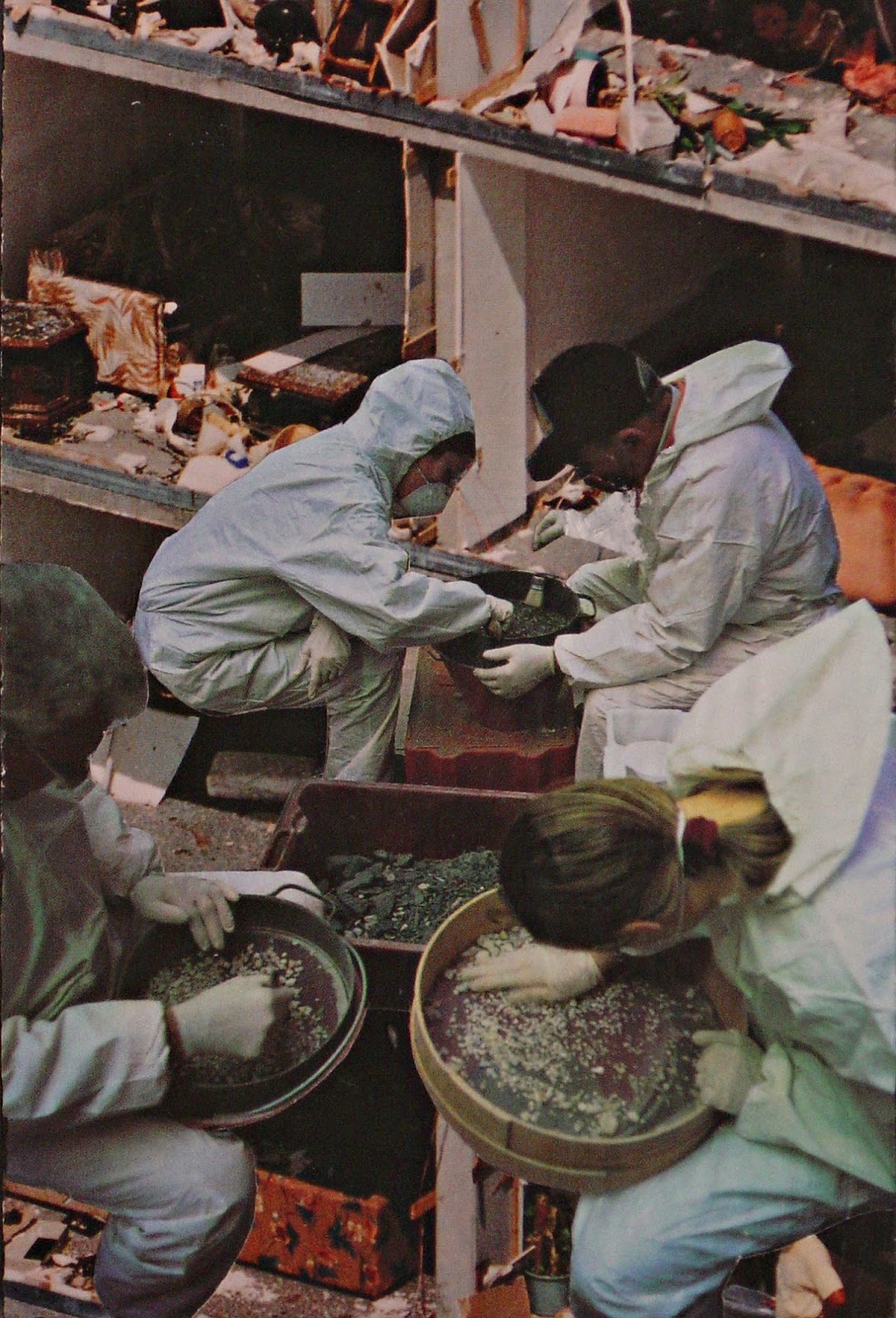
Proper Responses (2009) (9" x 12")
collage on paper

James outlines three situations when one should turn to God for help: when we are suffering, cheerful or sick. In addition, he appears to couple sickness with sinfulness in verses 15 and 16. But these are probably two separate thoughts in line with Jesus' teachings to his apostles that there is not necessarily a cause-and-effect relationship between the two.

Monday, April 28, 2014

James 5:12

Black and White (2009) (9" x 12")
collage on paper

After all of the important teachings that have preceded this verse, James unexpectedly begins his warning against taking oaths by saying, "Above all..."  Although this is not a trivial subject by any means, this opening phrase should better be translated, "And in conclusion..."

Again, in these verses, James echoes the sayings of Christ, who explains that we should not swear by anything at all since whatever we swear by (whether by God or by the hairs on our chinny-chin-chin) is beyond our personal control.

Saturday, April 26, 2014

James 5:7-11

Patience (2009) (9" x 12")
collage on paper

These verses give advice on how to live your life in light of the fact that Christ is coming again soon. Instead of selling your property and going to a mountain top or walking around with a sign "The End is Coming," one is to live patiently in the presence of trials and not complain about other Christians---in other words, live your life normally.

Thursday, April 24, 2014

James 5:1-6

Hard Evidence (2009) (9" x 12")

In the Sermon on the Mount, one of Jesus' reasons for our not trusting in wealth is that it doesn't last. He even uses the same word "rust" that James employs in this passage--the word can stand for any sort of decay.
/There is nothing wrong with wealth itself, but it should be used for good (creating jobs, charity) and not just accumulated. One commentator has said, “Most all people who are able to save and invest experience the temptation to drastically overestimate their genuine needs and/or try to secure their futures against all calamity.”The result is stored resources that could have been used more wisely. Those excess resources will be used as evidence against us at the Judgment.

Tuesday, April 22, 2014

James 4:13-17

Misty (2009) (9" x 12")
collage on paper

These verses express a hard saying that seemingly discourages us from planning for the future (much as Jesus does in the Sermon on the Mount). However, the real thrust of the passage is to remind us that our life is fleeting and totally in God's hands. We should keep this in mind whenever we make detailed plans for the future.

Sunday, April 20, 2014

James 4:11-12

One and Only (2009) (9" x 12")
collage on paper

These verses sound a warning against those who choose to point a finger at others. James says, in effect, that we are judging ourselves when we do this. Ultimately, there is only one supreme judge who can condemn us or forgive us, and that is God.

Friday, April 18, 2014

James 4:1-10

Perfect Mayhem (2009) (9" x 12")
collage on paper

Again in these verses James echoes the thoughts of Jesus in the Sermon on the Mount. He castigates those who are in love with material possessions and pray to God for more. Such people are double-minded in that they seek both God and Mammon and can't have both. This leads inevitably to conflicts with those around them.

Wednesday, April 16, 2014

James 3:13-18

Up and Down (2009) (9" x 12")
collage on paper


Paraphrasing C. S. Lewis: We should view each person we meet as either the most glorious angel or as the most hideous demon since one of the two will be the ultimate fate of each of us.

Monday, April 14, 2014

James 3:1-12

Out of Control (2009) (9" x 12")
collage on paper

The power of words is the subject of these verse, which echo the teachings in the Book of Proverbs. James highlights the uses of the tongue by employing both positive (steering ships, riding horses) and negative (wildfire, poison) images.

Friday, April 11, 2014

James 2:14-26

Faith is a Verb (2009) (9" x 12")
collage on paper

One confusing issue for many Christians is the seeming discrepancy between James and Paul concerning the question of faith versus works. This is especially true since both authors use Abraham as a prime example to prove their respective ideas.
The best solution I have found to resolve the issue is to consider a basic principle of hermeneutics (the science and art of interpretation). One should always let an author define his own words. So an instructive exercise is to go through the key passages in Paul and James and write down how each one of them defines the words faith, work and law. You will soon see that there is no contradiction between their teachings, just slight differences in how they define their terms.

Tuesday, April 8, 2014

James 2:8-13

Transgressors (2009) (9" x 12")
collage on paper

This is an interesting passage in that James plays on the various meanings of the word "law."  First he states (as did Jesus in the Sermon on the Mount) that we are still liable for judgment under the laws of the Ten Commandments. However, we are to speak and act under the commands of a new law, the law of liberty (also mentioned in James 1:25). And if we do, then we will be judged mercifully by God.

Monday, April 7, 2014

James 2:1-7

Cross of Gold (2009) (9" x 12")
collage on paper

James gives a powerful example in these verses that is still applicable today. The question is, "How to we view visitors to our church services?" Is it according to their socio-economic status or their status as someone that Christ died for?

Saturday, April 5, 2014

James 1:26-27

Pure Religion (2009) (9" x 12")
collage on paper

These verses do a wonderful job of encapsulating the basics of Christian behavior in two areas that must both be embraced by the believer: maintaining purity in an impure world and entering into the world to help those in distress. Unfortunately, many Christian groups gravitate toward one or the other and thus become either exclusive separatists or those who preach the social gospel only.

Wednesday, April 2, 2014

James 1:22-25

Amnesia (2009) (9" x 12")
collage on paper

In these verses, James compares those who are self-deceived (hearers of the word who refuse to follow through with concrete actions) to those who look in a mirror but soon afterward forget what they look like. This collage features a picture of Agatha Christie at her desk since she actually did suffer from an episode of amnesia once.


Monday, March 31, 2014

James 1:19-21

His Master's Voice (2009) (9" x 12")
collage on paper

James echoes Proverbs in the first part of this passage urging us to "be quick to listen, slow to speak, slow to anger."  But, he continues, you must also rid yourself of all sordidness in order to hear God's word and plant it in your heart.

Saturday, March 29, 2014

James 1:17-18

Shadowless (2009 (9" x 12")
collage on paper

These verses describe the unchangeable God as the Father of lights who "gave us birth by the word of truth. Note the contrast with verse 15, which described the process by which evil desire "gives birth to death."

Friday, March 28, 2014

James 1:12-16

Death's Life Cycle (2009) (9" x 12")
collage on paper

These verses form a sort of contrast to James 1:2-4, which describes the spiritual growth caused in a believer by the process of testing and trials. In verses 12-16, the final result of giving in to temptation is seen as spiritual death.

Thursday, March 27, 2014

James 1:9-11

Ups and Downs (2009) (9" x 12")
collage on paper

A reversal of fates is a common theme in the Bible. Living in central Texas, I especially like the image of the rich being compared to wildflowers in a field that bloom and then wither in the heat of the sun.

Tuesday, March 25, 2014

James 1:5-8

Wavering (2009) (9" x 12")
collage on paper

James admonishes his readers to petition God in faith and not be double-minded. This last term is a very rare word appearing in the New Testament only here and in James 4:8 where he applies it to those Christians who are having trouble resisting temptation.

Monday, March 24, 2014

James 1:2-4

Topsy-Turvy Teaching (2010) (9" x 12")
collage on paper

The result of trials, according to James is so that we can become "mature and perfect."  This seems like a high goal, but it is an echo of Jesus' teaching in the Sermon on the Mount to "be perfect as your heavenly Father is perfect." One commentator has explained that perfection means being all that we can become.

Saturday, March 22, 2014

James 1:1

This is the first in a series of posts illustrating all of the Letter of James.

To the Tribes (2010) (9" x 12")
collage on paper

James addresses this letter to the "twelve tribes in the Dispersion (or diaspora)."  If taken literally, this would mean that he is writing exclusively to Jewish Christians. However, most commentators take this address to mean the Christian community (both Jewish and gentile) at large. This meaning is consistent with usage elsewhere in the NT epistles employing terms formerly designating the Jews as God's chosen people, but now enlarged to include gentile believers.

Thursday, March 20, 2014

Isaiah 13:19-22

Mansion or Menagerie? (2011) (6" x 4")
collage on wood panel

In keeping with the recent spate of apocalyptic movies like World War Z, it is interesting to note that the Old Testament prophets similarly warned the people of their day that any civilization stands only if God allows it. Even Babylon was overthrown to become a place where "wild animals will lie down and its houses will be full of howling creatures." 

Tuesday, March 18, 2014

Matthew 12:38-40

Type (2009) (6 3/4" x 8" x 1 1/2")
collage in linotype box

I keep coming back to the interesting parallels between Jesus' life and that of Jonah. The most famous one, of course, is the three days and three nights in the belly of the whale compared to Jesus' time in the tomb. While scholars continue to debate the exact days of the week included in the latter event, it is interesting to note that there was an ancient belief that a dead person had to travel three days after death to reach Hades.

Sunday, March 16, 2014

Mark 16:9-20

Dubious Denoument (2009) (32" x 16 3/4" x 1 1/4")
collage in type case

If most of you try to look up these verses in your Bible, they will be missing or given in small type. This is because they are not present in the earliest existing manuscripts of Mark that we possess. There are several theories to account for their appearance in later manuscripts. The most popular one is that Mark either intended to end his Gospel at verse 8 or that the original ending was lost early in the process of transmission. In either case, someone later on appended verses 9-20 to provide a "more appropriate" ending.

My own feeling, based on structural analysis, is that the last verses of Mark's original Gospel were lost, but that we can go to the ending of Luke's Gospel to get a good idea of how it originally read.

Friday, March 14, 2014

Leviathan

God's Plaything (2009) (32 1/4" x 16 1/2" x 1 3/8")
mixed media in type case

Many other ancient Near Eastern societies had myths involving sea monsters representing forces of chaos that were at war with the deities. However, Leviathan in the Bible (Psalm 104:26 and Job 40-41) is pictured as a sort of bath toy for God.

Thursday, March 13, 2014

John 4

Living Water (2004) (9 3/4" x 2" x 8 1/2")
mixed media construction in wood box

 This strange piece is hard to picture since it was constructed in an antique sewing machine parts box with figures formed from the parts themselves. It shows Jesus talking with the Samaritan woman at the well and trying to explain to her the concept of living water. As usual, even with his disciples, she takes his words literally instead of figuratively. Nevertheless, the words have their intended effect and result in others in the village coming to hear Jesus.

Sunday, March 9, 2014

John 2

Transformed Water (2004) (9 3/4" x 2" x 8 1/2")
Construction in water testing kit

The first half of John's Gospel is arranged around seven "I am" sayings of Jesus, seven feasts of the Jews, and seven miracles. The turning of the water into wine at Cana is the first of the miracles, or "signs" as John prefers to call them. This sign not only shows Jesus' power over natural laws; it also points to his Father, who also changes water to wine using a slower process. 

Friday, March 7, 2014

Exodus 15

Bitter Waters (2004) (7 7/8" x 3 3/8" x 2 1/2")
mixed media construction in wood box

During the Israelites' wanderings in the wilderness they came upon a a source of water but it was too bitter to drink. God showed Moses a piece of (charred?) wood which was thrown into the water so that it became drinkable. As a scientist, I know that activated charcoal can be used to remove trace contaminants from water, which is possibly the "explanation" of this miracle.

However, the miracle consists of the proper knowledge imparted to Moses just when he needed it, and the existence of the very wood near at hand. It is somewhat the same as the coincidence of me happening to find an old medicine bottle which had an inscription containing the words "Moses," "formerly," "bitter," and "wood." 

Wednesday, March 5, 2014

Numbers 5


Waters of Testing (2004) (10 3/4" x 5" x 3 1/2")
mixed media construction

One of the strangest rituals in the Bible is this passage in which a woman accused of unfaithfulness by her husband is subjected to a trial in which she must drink a wierd concoction while holding two sheaves of wheat in her hands. Without going into all the details, it is obvious that the trial is weighted heavily in favor of the wife and was meant to discourage unfounded suspicions by her husband.

Monday, March 3, 2014

Numbers 19

Waters of Impurity (2004) (3 1/2" x 4 1/4" x 12 1/4")
mixed media construction in wood box

This chapter contains the regulations and rites concerning the purification of a person who has come into contact with a dead body. As with many of the other laws concerning ritual purity, the means of counteracting it may seem to be arbitrary. However, the major import of these rules was to stress the gap between man and God--a gap that was only removed by Jesus shedding his blood on the cross. This sacrifice is prefigured in Numbers 19 by the killing of a perfect heifer and sprinkling its blood toward the tent of meeting.

Saturday, March 1, 2014

Amos 9:9

Shaken, Not Stirred (2011) (4" x 6")
collage on wood panel

God's revelation to Amos is one of separation. He will destroy the sinful kingdom of Israel, and all its sinners "shall die by the sword." However, God holds out hope for a remnant in verses 11-12. As the note in my NRSV Study Bible says, "Amos refutes the idea that Israel's relationship with God implies its superiority" or will protect them from God's righteous judgment. Something for Americans to keep in mind.

Thursday, February 27, 2014

I Corinthians 10:31

Give Thanks (2011) (6" x 4")
collage on wood panel

"So, whether you eat or drink, or whatever you do, do everything for the glory of God."  It is hard for us to apply Paul's words to every activity in our daily life since much of it seems to have little or nothing to do with God. Paul, however, is exhorting us to consider God and his daily provision for us constantly in these very activities.

Wednesday, February 26, 2014

I Kings 7

The precious vessels of the Lord that are described in verses 48-50 of this chapter are a source of temptation for both Israel's leaders (who love to show them off to visitors as if they were their own possession) and for neighboring rulers (who later took them to be used for profane purposes, as described in a recent post).

The time, talents and treasures that God gives us are to be held in trust and used for the benefit of His kingdom.

 Vessels of the Lord (2011) (6" x 4")
collage on wood panel

Sunday, February 23, 2014

The Structure of Genesis

The Book of Genesis is divided into 10 separate sections, each basically beginning with the phrase "These are the generations of."  A careful analysis shows that in each of these literary units there is a form of symmetry in the various stories and the way they are told. This symmetry is barely perceptible in the first few units and slowly evolves as one proceeds into the book. The last section, the Joseph saga, is beautifully arranged in terms of large literary units, intermediate ones, and right down to individual verses. In other words, structure evolves from chaos just as God created order out of disorder.

Conquering Chaos (2009) (32" x 16 1/2")
construction in type case

Saturday, February 22, 2014

Daniel 5

The phrase "handwriting on the wall" comes from this eerie story of a disembodied hand writing four words on the wall of King Belshazzar's palace, spelling out his fate.  The reason for God's judgment on him was that he had taken the sacred vessels captured by his father from the Temple in Jerusalem and used them for profane purposes.

 Handwriting on the Wall (2004) (14 1/2" x 30")
collage and acrylic on canvas

Thursday, February 20, 2014

Daniel 10

The last three chapters of Daniel constitute a single vision. The vision is inaugurated by the appearance of a man clothed in linen with a belt of gold. Most scholars feel this is the angel Gabriel. His description is similar to those found in Exekiel 9 and Revelation 1. All three books fall into the category of apocalyptic literature-- a literary genre that differs in many ways from that of prophecy. One of the distinctions between the two is illustrated in Daniel 9: Prophecy is usually given orally to a man directly from God while in apocalyptic literature, it is an intermediary who does the revealing and it is in the form of visions.

Behold, A Man (2004) (14 1/2" x 30")
mixed media on canvas

Tuesday, February 18, 2014

Daniel 2

This chapter tells the story of King Nebuchadnezzar and his dream of a statue with feet of clay. Daniel receives the meaning of the vision in a dream. Its interpretation involves four kingdoms, the last of which will be destroyed by a non-human force.  This the first of several such visions in Daniel, each of which appears to cover the same basic time frame but each one advancing slightly chronologically.

Such a phenomenon is called progressive recapitulation, which is also the most compelling theory on how the visions in the Book of Revelation should be viewed. This is in contradiction to the more common view that the whole book should be viewed as visions set out in a strictly chronological manner.

Feet of Clay (2004) (14 1/2" x 30")
mixed media on canvas

Monday, February 17, 2014

The Beatitudes (John)

When you think of Beatitudes, the Book of Revelation seldom comes to mind. However, there are just as many Beatitudes (blessings) found there as in the Sermon on the Mount--count them some time.

Beatitudes (John) (2013) (12" x 12")
collage and acrylic on canvas

Friday, February 14, 2014

The Beatitudes (Luke)

The beatitudes found in Luke's version of the Sermon on the Mount (Luke 6:20-26) different somewhat from those in Matthew's account. For one thing, only about half of Matthew's beatitudes are included. Also, Luke gives a corresponding curse with each beatitude for those who do not heed. This different structure is reflected in the abstract composition below.

Beatitudes (Luke) (2013) (12" x 12")
collage on canvas

Wednesday, February 12, 2014

The Beatitudes (Matthew)


 Beatitudes (Matthew) (2013) (12" x 12")
collage and acrylic on canvas

The most familiar beatitudes are found in Mark's Gospel, Chapter 5. It is a perfect way for Jesus to begin his Sermon on the Mount, with God's promises before leading into the demands on a follower.