Monday, March 3, 2014

Numbers 19

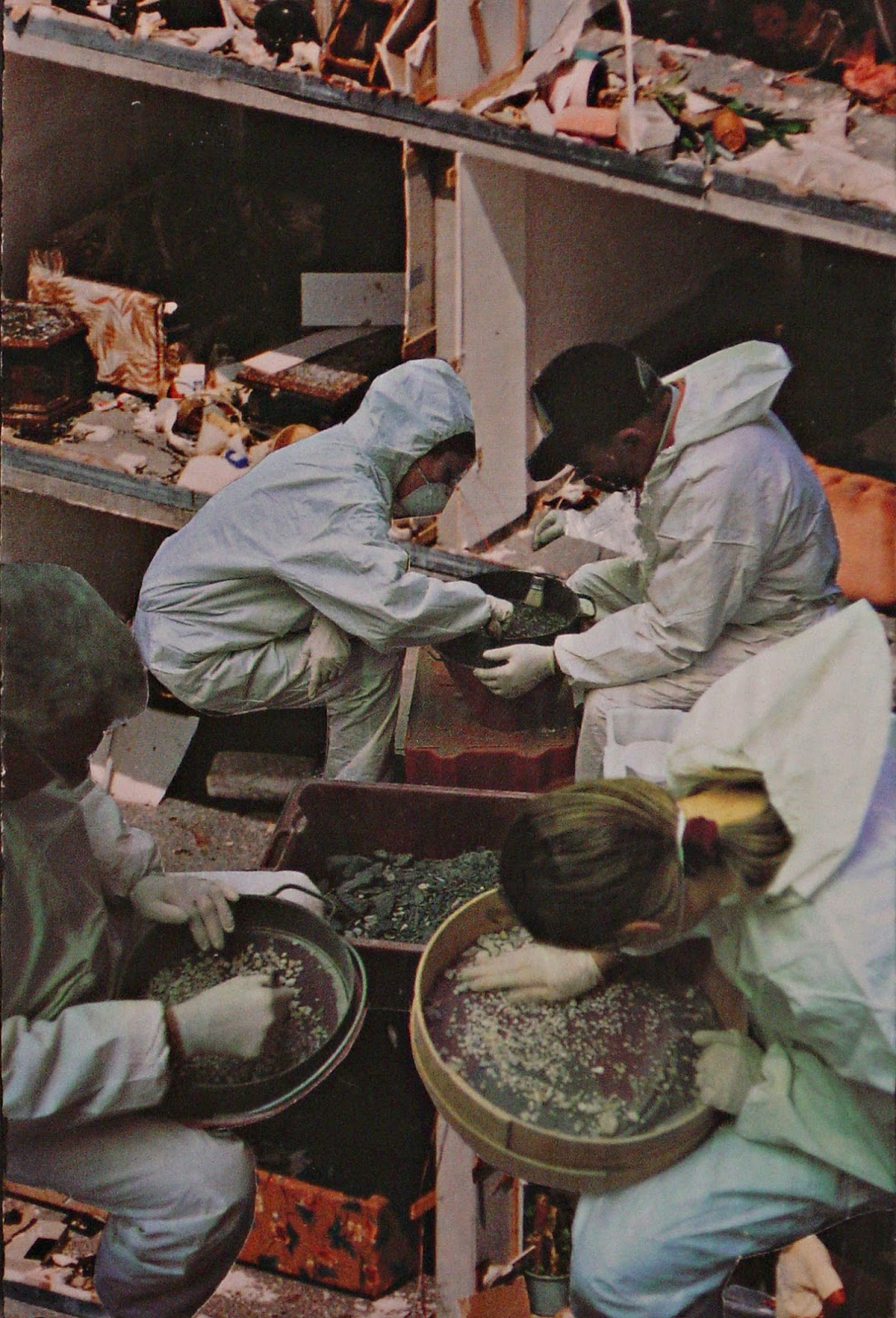
Waters of Impurity (2004) (3 1/2" x 4 1/4" x 12 1/4")
mixed media construction in wood box

This chapter contains the regulations and rites concerning the purification of a person who has come into contact with a dead body. As with many of the other laws concerning ritual purity, the means of counteracting it may seem to be arbitrary. However, the major import of these rules was to stress the gap between man and God--a gap that was only removed by Jesus shedding his blood on the cross. This sacrifice is prefigured in Numbers 19 by the killing of a perfect heifer and sprinkling its blood toward the tent of meeting.

Saturday, March 1, 2014

Amos 9:9

Shaken, Not Stirred (2011) (4" x 6")
collage on wood panel

God's revelation to Amos is one of separation. He will destroy the sinful kingdom of Israel, and all its sinners "shall die by the sword." However, God holds out hope for a remnant in verses 11-12. As the note in my NRSV Study Bible says, "Amos refutes the idea that Israel's relationship with God implies its superiority" or will protect them from God's righteous judgment. Something for Americans to keep in mind.

Thursday, February 27, 2014

I Corinthians 10:31

Give Thanks (2011) (6" x 4")
collage on wood panel

"So, whether you eat or drink, or whatever you do, do everything for the glory of God."  It is hard for us to apply Paul's words to every activity in our daily life since much of it seems to have little or nothing to do with God. Paul, however, is exhorting us to consider God and his daily provision for us constantly in these very activities.

Wednesday, February 26, 2014

I Kings 7

The precious vessels of the Lord that are described in verses 48-50 of this chapter are a source of temptation for both Israel's leaders (who love to show them off to visitors as if they were their own possession) and for neighboring rulers (who later took them to be used for profane purposes, as described in a recent post).

The time, talents and treasures that God gives us are to be held in trust and used for the benefit of His kingdom.

 Vessels of the Lord (2011) (6" x 4")
collage on wood panel

Sunday, February 23, 2014

The Structure of Genesis

The Book of Genesis is divided into 10 separate sections, each basically beginning with the phrase "These are the generations of."  A careful analysis shows that in each of these literary units there is a form of symmetry in the various stories and the way they are told. This symmetry is barely perceptible in the first few units and slowly evolves as one proceeds into the book. The last section, the Joseph saga, is beautifully arranged in terms of large literary units, intermediate ones, and right down to individual verses. In other words, structure evolves from chaos just as God created order out of disorder.

Conquering Chaos (2009) (32" x 16 1/2")
construction in type case

Saturday, February 22, 2014

Daniel 5

The phrase "handwriting on the wall" comes from this eerie story of a disembodied hand writing four words on the wall of King Belshazzar's palace, spelling out his fate.  The reason for God's judgment on him was that he had taken the sacred vessels captured by his father from the Temple in Jerusalem and used them for profane purposes.

 Handwriting on the Wall (2004) (14 1/2" x 30")
collage and acrylic on canvas

Thursday, February 20, 2014

Daniel 10

The last three chapters of Daniel constitute a single vision. The vision is inaugurated by the appearance of a man clothed in linen with a belt of gold. Most scholars feel this is the angel Gabriel. His description is similar to those found in Exekiel 9 and Revelation 1. All three books fall into the category of apocalyptic literature-- a literary genre that differs in many ways from that of prophecy. One of the distinctions between the two is illustrated in Daniel 9: Prophecy is usually given orally to a man directly from God while in apocalyptic literature, it is an intermediary who does the revealing and it is in the form of visions.

Behold, A Man (2004) (14 1/2" x 30")
mixed media on canvas

Tuesday, February 18, 2014

Daniel 2

This chapter tells the story of King Nebuchadnezzar and his dream of a statue with feet of clay. Daniel receives the meaning of the vision in a dream. Its interpretation involves four kingdoms, the last of which will be destroyed by a non-human force.  This the first of several such visions in Daniel, each of which appears to cover the same basic time frame but each one advancing slightly chronologically.

Such a phenomenon is called progressive recapitulation, which is also the most compelling theory on how the visions in the Book of Revelation should be viewed. This is in contradiction to the more common view that the whole book should be viewed as visions set out in a strictly chronological manner.

Feet of Clay (2004) (14 1/2" x 30")
mixed media on canvas

Monday, February 17, 2014

The Beatitudes (John)

When you think of Beatitudes, the Book of Revelation seldom comes to mind. However, there are just as many Beatitudes (blessings) found there as in the Sermon on the Mount--count them some time.

Beatitudes (John) (2013) (12" x 12")
collage and acrylic on canvas

Friday, February 14, 2014

The Beatitudes (Luke)

The beatitudes found in Luke's version of the Sermon on the Mount (Luke 6:20-26) different somewhat from those in Matthew's account. For one thing, only about half of Matthew's beatitudes are included. Also, Luke gives a corresponding curse with each beatitude for those who do not heed. This different structure is reflected in the abstract composition below.

Beatitudes (Luke) (2013) (12" x 12")
collage on canvas

Wednesday, February 12, 2014

The Beatitudes (Matthew)


 Beatitudes (Matthew) (2013) (12" x 12")
collage and acrylic on canvas

The most familiar beatitudes are found in Mark's Gospel, Chapter 5. It is a perfect way for Jesus to begin his Sermon on the Mount, with God's promises before leading into the demands on a follower.

Saturday, February 8, 2014

Jeremiad

The term above is generally applied to extended laments in the style of Jeremiah the prophet. In the picture below, however, I apply it to the whole saga of Jeremiah's life much as the Aeneid portrays the life of Aeneas.

Jeremiad (2013) (24" x 18")
collage and acrylic on canvas

Thursday, February 6, 2014

Jonah 1 and Matthew 8:23-27

I have for some time been intrigued by the surface similarities between Jonah and Jesus, despite their overall differences. One such parallel is found in this post's title accounts. In both cases, there is a storm at sea and a boat is in peril. The main character, however, is oblivious since he is sleeping below. The sailors, in desperation, turn to him for help and he calms the sea to save them.

Type/Antitype (2013) (11" x 14")
collage on canvas


Tuesday, February 4, 2014

Philemon

This short and personal letter of Paul's reveals his wonderful ability to resolve an estrangement between two believers and, at the same time, to make some veiled comments regarding the institution of slavery.

Philemon (2014) (11 1/4" x 5" x 1 1/4")
mixed media assemblage on modified cigar mold

Monday, February 3, 2014

Joshua 6

"And Blow Your House Down" (2009) (10" x 10")
collage on framed mirror

I like the title of this piece better than the piece itself. 

The story of the conquest of Jericho is an interesting one from an archeological point of view. As subsequent teams of archeologists explore this ancient city, the veracity of the biblical account is either confirmed or denied. The latest good evidence from a Canadian team of scholars appears to be very consistent with the account in Joshua.

Saturday, February 1, 2014

Genesis 32

Night Wrestling (2009) (10" x 10")
collage on framed mirror

Jacob again finds himself at the border of his homeland, this time returning instead of fleeing, and again (as with the dream of the ladder to heaven) has a heavenly encounter. The footnote to my NRSV Study Bible notes perceptively, "Jacob had feared to see Esau's face (v. 20), but instead saw God face to face and lived." 

Thursday, January 30, 2014

Genesis 24

Mail Order Bride (2009) (10" x 10")
collage and acrylic on framed mirror

Abraham's servant is sent to the city of Nahor where he is to locate a bride for Isaac who will be identified by her actions at a well. Rebekah is identified by the predicted sign so the servant goes to her father and her brother Laban and explains that she is the chosen one. Laban very piously answers, "The thing comes from the LORD; we cannot speak to you anything bad or good. Look, Rebekah is before you, take her and go, and let her be the wife of your master's son, as the LORD has spoken."

From what we know about Laban's money-grubbing attitude elsewhere in the Bible, this response seems out of character for him. But the answer is probably hinted in verses 30-31 where we see that Laban only welcomes the servant with open arms once he has seen the costly nose rings and bracelets the servant had given Rebekah as presents.

Wednesday, January 29, 2014

Genesis 28:10-22

Highway to Heaven (2009) (10" x 10")
collage on framed mirror

The famous story of Jacob's Ladder has been seen by some to anticipate the atoning work of Christ in bridging the gap between man and God.

Tuesday, January 28, 2014

Exodus 28 and Exodus 39

These chapters describe in detail all the vestaments for the Aaronic priesthood. They are of special interest to artists, as Francis Schaeffer pointed out years ago in his little pamphlet which has the same title as my blogsite. Note the number of times in these passages that God stresses the skillfullness of the artistry to be done. And lest anyone take pride in their artistic accomplishments, note also Exodus 28:3:  "And you shall speak to all who have ability, whom I have endowed with skill..."

All Decked Out (2009) (10" x 10")
collage on framed mirror

Monday, January 27, 2014

Exodus 3

As Moses approaches the burning bush in the desert, a voice tells him, "Remove the sandals from your feet, for the place on which you are standing is holy ground." I had always interpreted this to mean that Moses should take off his dirty shoes so that they would not pollute the holy ground, much as people in many Far East cultures take off their shoes before they enter a house or place of worship.

However, I recently read a completely different interpretation of this passage. Namely, God wants Moses to come into more direct contact with Him by removing his sandals.

Brushfire (2009) (10" x 10")
collage on framed mirror

Saturday, January 25, 2014

Exodus 32

Calf Casting (2009) (10" x 10")
collage and acrylic on framed mirror

The unfortunate Golden Calf incident in Exodus 32 demonstrates mankind's tendency to worship something they can not only see, but have control over--unlike the invisible and omnipotent God.

Friday, January 24, 2014

Numbers 20

Twice Struck (2009) (10" x 10")
mixed media on framed mirror

After one of the Israelite grumbling episodes (Why did you bring us here where there is no water or fruit as in Egypt?), Moses and Aaron pray to God for water. He tells them to command a rock to bring forth water, but Moses strikes the rock twice and takes credit for the miracle himself (see verse11).

As punishment for their disobedience, Moses and Aaron are not allowed to take the people into the Promised Land. Sometimes a seemingly minor act can reveal the condition of our heart and have grave consequences.

Thursday, January 23, 2014

Numbers 2

Encamped (2009) (10" x 10")
collage on framed mirror

Verses 15-23 of this chapter hold a good lesson for us today. God's presence with the people was indicated by a cloud resting over the tabernacle. The people would stay camped at each location until the cloud lifted. In other words, they only proceeded when and where God indicated. We often charge ahead of God in our life and regret it later.

Wednesday, January 22, 2014

Numbers 21

This chapter contains the strange story of the Israelites grumbling against God, who proceeds to plague them with poisonous snakes. Then, after Moses' intervention, God instructs him to erect an image of a snake which will heal anyone who looks on it. Perhaps there is a hint here of God sending his Son to first remind us of our sinful nature and then saving anyone who gazes upon his sacrifice on the cross.

Sympathetic Healing (2009) (10" x 10")
collage on framed mirror

Tuesday, January 21, 2014

Exodus 34

The Big Ten (2009) (10" x 10")
collage on framed mirror

The Ten Commandments remain the basis of morality for Jews and Christians today. However, in case you are ever tempted to feel that your life is without sin because you haven't broken any commandments (lately), just read Matthew 5. In Jesus' Sermon on the Mount, he takes several of these commandments and goes to the heart of the matter rather than just concentrating on overt actions. And in addition he adds a commandment that all of us have trouble with: love your enemies.

Monday, January 20, 2014

2 Peter 3:15-16

The warning in these verses is clear: some things in the Bible are hard to understand and can be easily misread by those who either (a) don't know any better or (b) are purposely twisting Scripture to say what they want it to say.  Hopefully, we are not in the second class of people. However, all of us could use more training in how to interpret the Bible properly. My recommendation is a great little book by Gordon Fee entitled How to Read the Bible for All Its Worth.

Puzzling (2010) (6" x 4")
collage on balsa wood

Saturday, January 18, 2014

Matthew 13:45-46

Matthew 13 contains several short parables by Jesus describing various aspects of the Kingdom of Heaven. This saying about the "pearl of great price" zeroes in on how we should value God's kingdom as if it were something we would be willing to trade everything we own to obtain.


The Pearl (2010) (4" x 6")
collage on balsa wood

Friday, January 17, 2014

Ezekiel 37

This chapter has often been used to prove that the concept of a future resurrection was well known in Old Testament times. However, in its context, it really is a symbolic representation of Israel's rebirth as a nation. If one is looking for a proof text, Daniel 12:2 is a much clearer example:
        "Many of those who sleep in the dust of the earth shall awake, some to everlasting life, and some to shame and everlasting contempt."

Valley of Dry Bones (2010) (4" x 6")
collage on balsa wood

Thursday, January 16, 2014

James 3:5-6

Of all the sinful behaviors James mentions in his letter (including envy, ambition, murder, and fraud), he spends the most time talking about sins of the tongue. We need to remind ourselves constantly that gossiping, for example, ranks right up there with what we generally consider to be much more serious sins. However, as James puts it, "How great a forest is set ablaze by a small fire."

The Talk of the Town (2010) (6" x 4")
collage on balsa wood

Wednesday, January 15, 2014

II Kings 2:23-24

The story of Elisha cursing the young boys who were making fun of him, followed by them being killed by bears, is a disturbing one that most of us wish were not in the Bible. Walter Kaiser, Jr. (in Hard Sayings of the Bible) notes several facts that temper this story: the "young boys" involved were from 12-30 years of age; their taunt "go up" may refer to their unbelief in Elijah's translation into heaven; calling Elisha "baldhead" was quite derogatory (see Isaiah 3:17, 24) and might even be interpreted as cursing him with leprosy; Leviticus 26:21-22 predicts this sort of result for those who do not listen to God; and Elisha did not take action himself against the gang of youths (at least 42 of them were involved) but left it up to God.

Don't Mess With a Prophet (2010) (4" x 6")
collage on balsa wood

Tuesday, January 14, 2014

Ecclesiastes 12:12 Again

This must be a favorite verse of mine because here is a second collage on Solomon's advice.

Much Study (2010) (4" x 6")
collage on balsa wood

Monday, January 13, 2014

Joshua 4


A Memorial Forever (2009) (10" x 10")
collage on wood plaque and dowels

When the Israelites miraculously cross the Jordan River, they are told to erect a memorial of stones in the middle of the river so that, in future times, they can point it out to their children and recount the story.
What kind of memorials to God's help are we putting in place to share with future generations?

Sunday, January 12, 2014

Ecclesiastes 12:12

It is interesting to compare several translations of this much-quoted scripture:
"Of making many books there is no end, and much study is a weariness of the flesh"  NRSV
"Be warned that writing books involves endless hard work, and that much study wearies the body."  Jerusalem Bible
"The use of books is endless, and much study is wearisome." New English Bible
"There is no end of opinions ready to be expressed. Studying them can go on forever, and become very exhausting!"  Living Bible
"There is no end to the writing of books, and too much study will wear you out."  Today's English Version

I could go on, but I am getting a bit wearied myself.

A Weariness of the Flesh (2010) (4" x 6")
collage on hardboard

Saturday, January 11, 2014

Luke 14:7-11

This parable of Jesus revolves around the custom of seating the guests at a banquet according to their social status, with the favored guests sitting near the head of the table. One seating himself in an honored spot runs the risk of being told to move aside for a more influencial guest. There is a parallel to this saying in the Proverbs:
          "Do not exalt yourself in the king's presence, and do not claim a place among great men; it is better for him to say to you, 'come up here,' than for him to humiliate you before a noble man.'"  (Proverbs 25:6-7)

The Seat of Honor (2010) (4" x 6")
collage on hardboard

Friday, January 10, 2014

Proverbs 15:1

This scripture contains the famous saying "A soft answer turns away wrath."  This idea is echoed in Proverbs 15:4a: "A gentle tongue is a tree of life."
Lest someone get the idea that we are to water down our comments to the point that no one will be offended, Proverbs 15:2 needs to be kept in mind also: "The tongue of the wise dispenses knowledge."

In other words, speak the truth in love.

Turning Away Wrath (2010) (4" x 6")
collage on hardboard

Thursday, January 9, 2014

Philippians 3:2

In this passage, Paul warns the church about three classes of people: dogs, evil doers, and those who mutilate the flesh.  The second group is self explanatory, and the third group probably refers to those Christians who still insisted on circumcision as a requirement for church membership.  But who were the "dogs?"

As a matter of fact, practically all commentators on this passage agree that there was only one class of people described by these three terms: the judiazers. "Dogs" is a particularly derisive term to use since these animals were considered by the Jews as scavengers in a class with hyenas and vultures.

Beware of Dog (2010) (4" x 6")
collage on hardboard

Wednesday, January 8, 2014

Matthew 20:25-28

In these verses, Jesus warns his disciples that "whoever wishes to be first among you must be your slave (NRSV translation)."  If more TV preachers and pastors of megachurches took this to heart, there would be fewer sensational scandals involving church leaders in our country.  But we must remember that Jesus' words apply first and foremost to ourselves.

The Greatest (2010) (4" x 6")
collage on hardboard

Tuesday, January 7, 2014

Judges 21:25

In Their Own Eyes (2011) (12" x 12")
collage on canvas

As a hammer blow throughout the Book of Judges is the phrase "They did what was right in their own eyes."  This sounds, to us liberty-loving Americans like a compliment. However, in the context of the book, it is a denunciation of those who rejected God's leading in favor of whatever pleased them at the time.

Monday, January 6, 2014

Four Gospels

Traditionally, it was Saint Irenaeus in the 2nd Century who first assigned symbols to the four authors of the Gospel accounts:
     Mark was a lion, Luke was an ox, John was an eagle, and Matthew was a  
winged man.

These were named in analogy to the four beasts described in Ezekiel 1:10 and Revelation 4:7.

  Four-Fold (2011) (12" x 12")
acrylic and collage on canvas

Thursday, January 2, 2014

Numbers 13:32-33

A pivotal incident in Israel's history occurs when they reach the promised land and spies are sent to scope out the land before entering.  Based on the majority report of the scouts regarding the strength of the people there, and ignoring the advice of Joshua and Caleb, the people of Israel overwhelming refuse to enter the land that God had for them. The result was 40 more years of wandering in the desert.

Several lessons can be gained from this event: be careful whom you listen to, don't let your fears override God's promises, and snap decisions can lead to lasting consequences.


Grasshopper Men (2011) (12" x 12")
collage and acrylic on canvas and wood